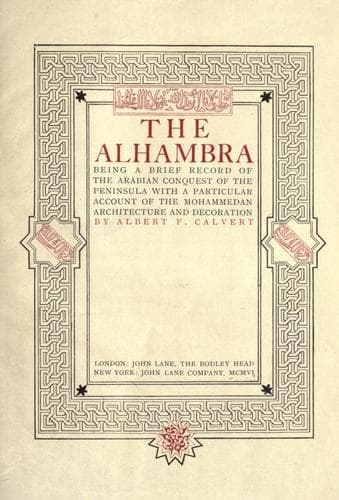
The Alhambra: being a brief record of the Arabian conquest of the Peninsula with a particular account of the Mohammedan architecture and decorationCalvert, Albert Frederick
Islamic
The Alhambra: being a brief record of the Arabian conquest of the Peninsula with a particular account of the Mohammedan architecture and decoration
[Illustration: CORNICES, CAPITALS, AND COLUMNS IN THE ALHAMBRA. THE
SPLENDID CORNICE AT THE RIGHT-HAND TOP CORNER IS FROM THE LOGGIA OF THE
GENERALIFE.]
[Illustration: CAPITALS FROM THE COURTS AND HALLS OF THE ALHAMBRA.]
A further charm is found in the works of the Arabs and Moors from their
conventional treatment of ornament, which, forbidden as they were by
their creed to represent living forms, they carried to the highest
perfection. They ever worked as Nature works, but always avoided a
direct transcript; they took her principles, but did not attempt to copy
her works.
It is true that the Arabs in Spain, as already pointed out, once or
twice allowed themselves to disregard the behests of the Korán, as
instanced in the Fountain of Lions, and the bas-relief which is now
preserved in the Museum of the Alhambra; but the Mohammedan mosques of
Egypt, India, and Spain, show everywhere the calm, voluptuous
translation of the doctrines of the Korán: an art in unison with its
imaginative and poetic teachings which led them to adorn their temples
in a manner peculiar to themselves.
COLOUR.
The colours employed by the Moors on their stucco work were in all
cases, the primaries--blue, red, and yellow (gold). The secondary
colours--purple, green, and orange, occur only in the Mosaic dados;
which, being near the eye, formed a point of repose from the more
brilliant colouring above. It is true that, at the present day, the
grounds of many of the ornaments are found to be green; it will readily
be seen, however, on a minute examination, that the colour originally
employed was blue, which, being a metallic pigment, has become green
from the effects of time. This is proved by the presence of particles of
blue colour, which occur everywhere in the crevices: in the
“restorations” also, which were made by the Catholic kings, green and
purple were freely used.
The colouring of the Courts and Halls of the Alhambra was carried out
on so perfect a motive, that anyone who cares to make this a study, can,
with almost absolute certainty, on being shown for the first time a
piece of Moorish ornament in white, define at once the manner in which
it was coloured. So completely were all the architectural forms
designed, with reference to their subsequent colouring, that the surface
alone will indicate the colours they were destined to receive.
Public-domain text, read in full here on John Shaqi.
Reviews
Reviews
No reviews yet
Be the first to share your thoughts on this work.
Join the Discussion
Join the discussion
Sign in to leave a comment or review.
Sign InorCreate an account