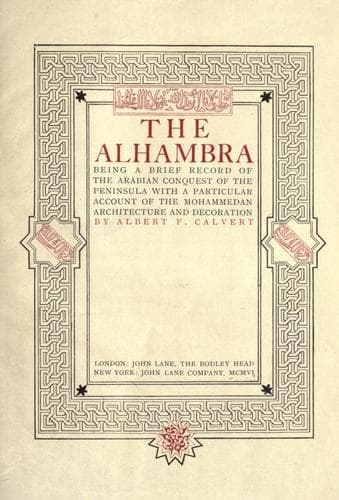
The Alhambra: being a brief record of the Arabian conquest of the Peninsula with a particular account of the Mohammedan architecture and decoration — John Shaqi
The Alhambra: being a brief record of the Arabian conquest of the Peninsula with a particular account of the Mohammedan architecture and decorationCalvert, Albert Frederick
Islamic
The Alhambra: being a brief record of the Arabian conquest of the Peninsula with a particular account of the Mohammedan architecture and decoration
Notwithstanding the fact that the Moors, in their marvellous system of
decoration, worked on fixed rules, the effect of their infinite variety
leaves the observer under the impression that they arrived at their
amazing achievements by instinct, to which centuries of refinement had
brought them. One person may naturally sing in tune as another does by
acquired knowledge. The happier state, however, is where knowledge
ministers to instinct, and this must have been the case with the Moors.
Their poet exhorts us to attentively contemplate the adornments of the
Palace, and so reap the benefit of a commentary on decoration; this
invitation seems to imply that there was in their works something to be
learned as well as much that might be felt.
Mr. Owen Jones admits that there is no authority for the gilding of the
columns: wherever the columns are of marble, the shafts are always free
from traces of colour of any kind. Gold, blue, and red are still seen on
most of the capitals, and, in some cases, the plaster half-columns
against the walls are covered by mosaic of a small pattern in glazed
earthenware. Nevertheless, the eminent authority on decoration is
strongly of opinion that the marble shafts could never have been,
originally, left entirely white; and, furthermore, he thinks that the
general harmony of the colouring above forbids such a supposition; but
the conclusion seems to be erroneous, when it is remembered that the
shafts of the columns are compared, in the graceful hyperbole of the
Inscriptions, to “transparent crystal;” and, again, “when struck by the
earliest beams of the rising sun, maybe likened to many blocks of
pearl.” Therefore, in view of the poetic reference by Moorish
versifiers, and the utter absence of any trace of colour on the marble,
it has been thought befitting to omit the gilding of the shafts in the
many reproductions in this volume from the beautiful coloured plates in
the work of Owen Jones. It should be recorded here that the book alluded
to is dedicated “To the Memory of Jules Goury, Architect, who died of
Cholera, at Granada, August 28th, 1834, whilst engaged in preparing the
original drawings for this work.”
Amongst the illustrations appearing on p. xlix. _supra_, which
principally consist of cornices, capitals, and columns in the Alhambra,
is a motto in Roman characters: TĀTO·MŌTA--Tanto Monta--pertaining to
Ferdinand and Isabella, and which is somewhat out of place in a page
otherwise devoted to Moorish ornament. The motto, of course, signifies
_tantamount_, and is meant to express an equality in power between the
two Sovereigns; Isabella zealously maintaining that her right of
exercising the royal authority was equivalent to that of her royal
consort: “_Tanto monta Isabella que Hernando, Hernando que
Isabella_”--of equal worth are Isabella and Ferdinand. The motto appears
in relief in the Court of the Lions.
Public-domain text, read in full here on John Shaqi.
Reviews
Reviews
No reviews yet
Be the first to share your thoughts on this work.
Join the Discussion
Join the discussion
Sign in to leave a comment or review.
Sign InorCreate an account