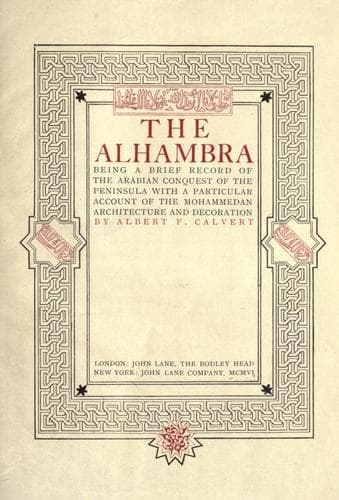
The Alhambra: being a brief record of the Arabian conquest of the Peninsula with a particular account of the Mohammedan architecture and decoration — John Shaqi
The Alhambra: being a brief record of the Arabian conquest of the Peninsula with a particular account of the Mohammedan architecture and decorationCalvert, Albert Frederick
Islamic
The Alhambra: being a brief record of the Arabian conquest of the Peninsula with a particular account of the Mohammedan architecture and decoration
To Mohammed the First, the world is indebted for the beautiful and
romantic Oriental monument, the Alhambra. This famous monarch was born
in Arjou in the year of the Hegira 591 (A.D. 1195), of the noble family
of the Beni Nasr, or children of Nasr, and no pains were spared by his
parents to fit him for the high station to which the opulence and
dignity of his family entitled him. When he reached manhood he was
appointed alcayde, or governor of Arjou and Jaen, and gained great
popularity by his benignity and justice. Some years afterwards, on the
death of Abou Hud, the Moorish power in Spain was broken into factions,
and many places declared for Mohammed. Being of a sanguine spirit and
lofty ambition, he turned the opportunity to his own purpose, made a
progress through the country, and was everywhere received with
acclamations. In the year 1232 he entered Granada, and was proclaimed
king with every demonstration of joy. Shortly afterwards he became the
head of the Moslems in Spain, being the second of the illustrious line
of Beni Nasr to sit upon the throne. His reign was such as to render him
a blessing to his subjects. He gave the command of his various cities to
those who had distinguished themselves by valour and prudence, and had
recommended themselves most acceptable to the people. He erected
hospitals for the blind, the aged and infirm, and all those incapable of
labour, visiting the asylums frequently--not on set days, with pomp and
form, so as to give time for everything to be put in order, and every
abuse concealed, but suddenly and unexpectedly, informing himself, by
actual observation and close enquiry, of the treatment of the sick, and
the conduct of those appointed to administer to their relief. He founded
schools and colleges, which he visited in the same manner, inspecting
personally the instruction of youth. He introduced abundant streams of
water into the city, erecting baths and fountains, and constructing
aqueducts and canals to irrigate and fertilize the _Vega_. By these
means prosperity and abundance prevailed in this beautiful city, its
gates were thronged with commerce, and its warehouses filled with
luxuries and merchandise of every country.
While Mohammed was ruling his fair dominions thus wisely and
prosperously, he was suddenly menaced with the horrors of war. The
Christians, profiting by the dismemberment of the Moslem power, were
rapidly regaining their ancient territories. James the Conqueror had
subjected all Valencia, and Ferdinand the Saint was carrying his
victorious arms into Andalusia. The latter invested the city of Jaen,
and swore not to strike his camp until he had gained possession of the
place. Mohammed was conscious of the insufficiency of his means to carry
on a war with the potent sovereign of Castile. Taking a sudden
resolution, therefore, he repaired privately to the Christian camp, and
made his unexpected appearance in the presence of King Ferdinand.
Public-domain text, read in full here on John Shaqi.
Reviews
Reviews
No reviews yet
Be the first to share your thoughts on this work.
Join the Discussion
Join the discussion
Sign in to leave a comment or review.
Sign InorCreate an account