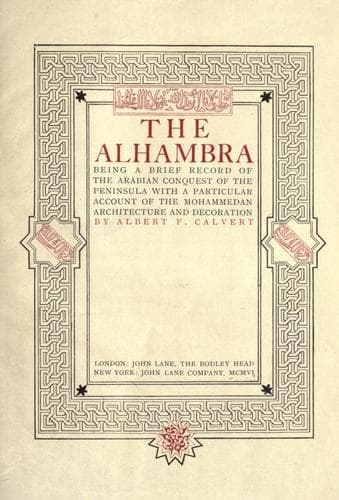
The Alhambra: being a brief record of the Arabian conquest of the Peninsula with a particular account of the Mohammedan architecture and decorationCalvert, Albert Frederick
Islamic
The Alhambra: being a brief record of the Arabian conquest of the Peninsula with a particular account of the Mohammedan architecture and decoration
“In me,” said he, “you behold Mohammed, king of Granada. I confide in
your good faith, and put myself under your protection. Take all I
possess, and receive me as your vassal.” So saying, he knelt, and kissed
the king’s hand in token of submission. Ferdinand, touched by this
instance of confiding faith, determined not to be outdone in generosity.
He raised his late rival from the earth, and embraced him as a friend,
leaving him sovereign in Granada, on condition of paying a yearly
tribute, attending the Cortes as one of the nobles of the empire, and
serving him in war with a certain number of horsemen.
It was not long after this that Mohammed was called upon for his
military services, to aid King Ferdinand in the siege of Seville. The
Moorish king sallied forth with 500 chosen horsemen of Granada, than
whom none in the world knew better how to manage a steed or wield the
lance. It was a humiliating service, however, to draw the sword against
brethren of the faith.
Mohammed gained but a melancholy distinction by his prowess in this
renowned campaign, but achieved more true honour by the humane methods
which he prevailed upon Ferdinand to introduce into the usages of war.
When, in 1428, the famous city of Seville surrendered to the Castilian
monarch, Mohammed returned sad, and full of care, to his dominions. He
saw the gathering ills that menaced the Moslem cause, and uttered the
ejaculation, often used by him in moments of anxiety and trouble: “_Que
angosta y miserabile seria nuestra vida, sino fuera tan dilatada y
espaciosa nuestra esperanza!_”--How straitened and wretched would be our
lives if our hope were not so spacious and extensive!
Sad and dispirited, the conqueror approached his beloved Granada. The
people thronged the streets with impatient joy: like to another
Coriolanus, “the dumb men flocked to see him, and the blind to hear him
speak;” for they loved him as a benefactor. Arches of triumph were
erected in his honour; and as he passed he was hailed with acclamations
as _Al Ghalib_, or the Conqueror. Mohammed shook his head when he heard
the appellation.
“_Wa la ghalib ila Alá!_” exclaimed he--There is no conqueror but God!
From that time forward he adopted the exclamation as a motto. He
inscribed it on an oblique band--in heraldry, a Bend--across his
escutcheon, and it continued to be the motto of his descendants.
Mohammed had purchased peace by submission to the Christians; but he
knew that where the elements were so discordant, and the motives for
hostility so deep and ancient, it could not be secure or permanent.
Acting, therefore, upon an old maxim, “Arm thyself in peace, and clothe
thyself in Summer,” he improved the interval of tranquillity by
fortifying his dominions, by replenishing his arsenals, and by promoting
those useful arts which give wealth and real power to an empire.
Public-domain text, read in full here on John Shaqi.
Reviews
Reviews
No reviews yet
Be the first to share your thoughts on this work.
Join the Discussion
Join the discussion
Sign in to leave a comment or review.
Sign InorCreate an account