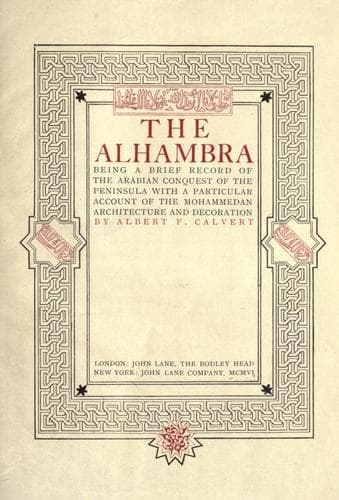
The Alhambra: being a brief record of the Arabian conquest of the Peninsula with a particular account of the Mohammedan architecture and decoration — John Shaqi
The Alhambra: being a brief record of the Arabian conquest of the Peninsula with a particular account of the Mohammedan architecture and decorationCalvert, Albert Frederick
Islamic
The Alhambra: being a brief record of the Arabian conquest of the Peninsula with a particular account of the Mohammedan architecture and decoration
[Illustration: “WA LA GHALIB ILA ALÁ!”--THERE IS NO CONQUEROR BUT
GOD!--THE FAMOUS MOTTO, IN KUFIC CHARACTERS, OF MOHAMMED I. AND HIS
SUCCESSORS, WHICH IS INSCRIBED ON THE WALLS OF THE ALHAMBRA IN COUNTLESS
REPETITION.]
He gave premiums and privileges to the best artisans, improved the breed
of horses and other domestic animals, encouraged husbandry, and
increased the fertility of the soil two-fold by his protection, making
the lovely valleys of his kingdom to bloom like gardens. He fostered,
also, the growth and fabrication of silk, until the looms of Granada
surpassed even those of Syria in the fineness and beauty of their
productions. He caused the prolific mines of gold and silver, and other
metals of the mountainous regions of his dominions, to be diligently
worked, and was the first King of Granada who, as we have seen, struck
money with his name, taking great care, moreover, that the coins should
be skilfully executed.
It was about this time, towards the middle of the thirteenth century,
and just after his return from the siege of Seville (1248), that
Mohammed commenced the splendid Palace of the Alhambra, superintending
the building of it in person, mingling frequently amongst the artists
and workmen, and directing their labour. He stored the gardens with the
rarest plants, and with the most beautiful aromatic shrubs and flowers.
Amid these scenes he delighted in reading histories, or in causing them
to be related to him; and sometimes, in intervals of leisure, employed
himself in the instruction of his three sons, for whom he had provided
the most learned and virtuous masters. Mohammed ever remained loyal to
Ferdinand, giving him repeated proofs of fidelity and attachment. When
that renowned monarch died at Seville in 1254, Mohammed sent ambassadors
to condole with his successor, Alonzo X., and with them a gallant train
of Moorish cavaliers of distinguished rank to attend the obsequies. This
grand testimony of respect was repeated by the Moslem monarch during the
remainder of his life on each anniversary of the death of King Fernando
el Santo, when a hundred Moorish knights repaired to Seville, and took
their stations with lighted tapers in the Cathedral, around the tomb of
the illustrious deceased.
Public-domain text, read in full here on John Shaqi.
Reviews
Reviews
No reviews yet
Be the first to share your thoughts on this work.
Join the Discussion
Join the discussion
Sign in to leave a comment or review.
Sign InorCreate an account