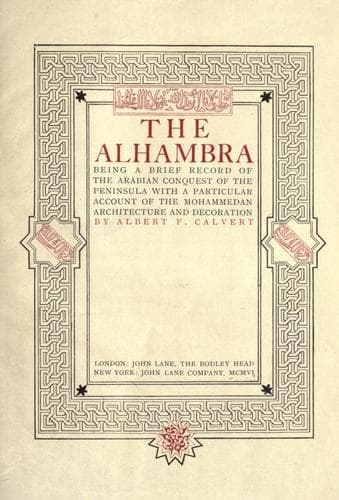
The Alhambra: being a brief record of the Arabian conquest of the Peninsula with a particular account of the Mohammedan architecture and decorationCalvert, Albert Frederick
Islamic
The Alhambra: being a brief record of the Arabian conquest of the Peninsula with a particular account of the Mohammedan architecture and decoration
Mohammed retained his vigour to an advanced age. In his seventy-ninth
year he took the field on horseback, accompanied by the flower of his
chivalry, to resist an invasion. As the army sallied forth from Granada,
one of the _adalides_, or guides, who rode in the advance, accidentally
shivered his lance against the arch of the gate. The counsellors of the
king, alarmed by the circumstance, which was considered an evil omen,
entreated him to return. The king persisted, and at noontide the omen,
say the Moorish chroniclers, was fatally fulfilled. Mohammed was
suddenly seen to fall from his horse. He was placed on a litter and
borne towards Granada, but his illness increased to such a degree that
they were obliged to pitch his tent on the _Vega_. His physicians were
filled with consternation, and in a few hours he died; the Castilian
prince, Don Philip, brother of Alonzo X., being by his side when he
expired. His body was embalmed, enclosed in a silver coffin, and buried
in the Alhambra, in a sepulchre of precious marble, amidst the unfeigned
lamentations of his subjects, who bewailed him as a parent.
Such was the enlightened prince who founded the Alhambra, whose name
remains emblazoned amongst its most delicate and graceful ornaments, and
whose memory is calculated to inspire the loftiest associations in those
who tread these fading scenes of his magnificence and glory.
Abu-el-Hejaj (Yúsuf I.), King of Granada, 1333-1354, who completed the
Alhambra.
In the royal Mosque, where the escutcheons of the Moorish kings hang
side by side with those of the Castilian sovereigns--for the Mosque was,
after the subjugation, consecrated as a Catholic chapel--perished the
illustrious Yúsuf Abu-el-Hejaj, the high-minded prince who completed the
Alhambra, and who, for his virtues and endowments, deserves almost equal
renown with its magnanimous founder. Washington Irving was, perhaps, the
first to draw forth, from the obscurity in which it had too long
remained, the name of another of those princes of a departed and almost
forgotten race, who reigned in elegance and splendour in Andalusia, when
all Europe was in comparative barbarism.
To Yúsuf I. the Alhambra owes much of its splendour; he not only
constructed the _Gate of Justice_ and the _Wine Gate_, leading into the
Palace, as appears from the inscriptions over their respective archways;
but he must also have built, or decorated, many of the interior
apartments, for his name appears frequently in _The Hall of the Two
Sisters_, in that of the _Baños_, in the _Court of the Fish-pond_, and
in the _Hall of the Ambassadors_.
Public-domain text, read in full here on John Shaqi.
Reviews
Reviews
No reviews yet
Be the first to share your thoughts on this work.
Join the Discussion
Join the discussion
Sign in to leave a comment or review.
Sign InorCreate an account