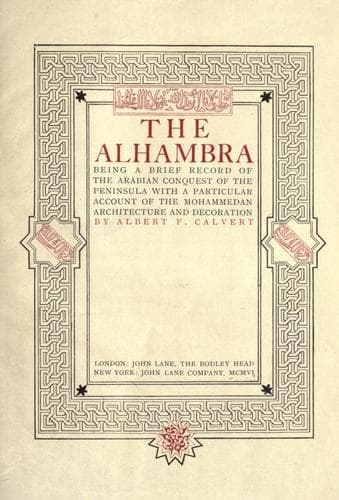
The Alhambra: being a brief record of the Arabian conquest of the Peninsula with a particular account of the Mohammedan architecture and decoration — John Shaqi
The Alhambra: being a brief record of the Arabian conquest of the Peninsula with a particular account of the Mohammedan architecture and decorationCalvert, Albert Frederick
Islamic
The Alhambra: being a brief record of the Arabian conquest of the Peninsula with a particular account of the Mohammedan architecture and decoration
Yúsuf ascended the throne of Granada in 1333. He is said to have been of
noble presence, possessing great bodily strength united to manly beauty.
He had the courage common to all generous spirits, but his genius
inclined more to peace than to war; and, though repeatedly obliged to
take up arms, he was generally unfortunate. Amongst other ill-starred
enterprises, he undertook a campaign in conjunction with the King of
Morocco, against Castile and Portugal, but was defeated in the memorable
battle of Salado; a reverse which nearly proved a death-blow to the
Moslem power in Spain.
A long truce, after this defeat, enabled Yúsuf to devote himself to the
instruction and improvement of his people. He established schools in the
villages, with uniform systems of education; he obliged every hamlet of
more than twelve houses to have a Mosque, and reformed abuses which had
crept into the religious ceremonies and festivals of the people. The
Alhambra was now completed. Yúsuf constructed the beautiful Gate of
Justice, forming the grand entrance, which he finished in 1348. He
likewise adorned many of the Courts and Halls of the Palace, as may be
seen by the inscriptions in which his name repeatedly occurs. He built
also the Alcázar, or Citadel of Malaga, of which, alas! only crumbling
traces remain.
[Illustration: THE WINE GATE, ATTRIBUTED TO YÚSUF I.]
The genius of the sovereign stamps a character upon his time. The nobles
of Granada, emulating the graceful taste of their monarch, filled the
city with magnificent palaces, the halls of which were adorned with
mosaics, the ceilings wrought in fretwork, and delicately gilded and
painted, or inlaid with precious woods; they had lofty towers of wood or
stone, carved and ornamented, and covered with plates of metal that
glittered in the sun. So refined was the taste in decoration prevailing
amongst this elegant people that, to use the simile of an Arabian
writer, “Granada, in the days of Yúsuf, was as a silver vase filled with
emeralds and jacynths.”
One anecdote will be sufficient to show the magnanimity of this generous
prince. The long truce which succeeded the battle of Salado was at an
end, and every effort of Yúsuf to renew it was in vain. His deadly foe,
Alonzo XI. of Castile,
[Illustration: HALL OF THE TWO SISTERS FROM THE ENTRANCE DOOR, BUILT BY
YÚSUF I.]
Public-domain text, read in full here on John Shaqi.
Reviews
Reviews
No reviews yet
Be the first to share your thoughts on this work.
Join the Discussion
Join the discussion
Sign in to leave a comment or review.
Sign InorCreate an account