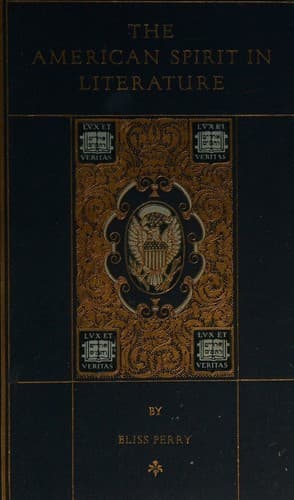
The American Spirit in Literature: A Chronicle of Great Interpreters — John Shaqi
The American Spirit in Literature: A Chronicle of Great InterpretersPerry, Bliss
History
The American Spirit in Literature: A Chronicle of Great Interpreters
Perry, Bliss
American literature -- History and criticism
To catch the full spirit of that age, turn for an instant to the London
of 1724--the year of Franklin's arrival. Thirty-six years have elapsed
since the glorious Revolution of 1688; the Whig principles, then
triumphant, have been tacitly accepted by both political parties; the
Jacobite revolt of 1715 has proved a fiasco; the country has accepted
the House of Hanover and a government by party leadership of the House
of Commons, and it does not care whether Sir Robert Walpole buys a few
rotten boroughs, so long as he maintains peace with Europe and
prosperity at home. England is weary of seventeenth century
"enthusiasm," weary of conflict, sick of idealism. She has found in the
accepted Whig principles a satisfactory compromise, a working theory of
society, a modus vivendi which nobody supposes is perfect but which will
answer the prayer appointed to be read in all the churches, "Grant us
peace in our time, O Lord." The theories to which men gave their lives
in the seventeenth century seem ghostly in their unreality; but the
prize turnips on Sir Robert's Norfolk farm, and the wines in his cellar,
and the offices at his disposal--these are very real indeed. London
merchants are making money; the squire and the parson are tranquilly
ruling the country parishes; the philosophy of John Locke is everywhere
triumphant. Mr. Pope is the poet of the hour, and his Essay on Man,
counseling acceptance of our mortal situation, is considered to be the
last word of human wisdom and of poetical elegance. In prose, the style
of the Spectator rules--an admirable style, Franklin thought, and he
imitated it patiently until its ease and urbanity had become his own.
And indeed, how much of that London of the third decade of the century
passed into the mind of the inquisitive, roving, loose-living printer's
apprentice from Philadelphia! It taught him that the tangible world is
the real world, and that nothing succeeds like success; but it never
even whispered to him that sometimes nothing damns like success.
In his limitations, no less than in his power of assimilation, Franklin
was the representative man of his era. He had no artistic interests, no
liking for metaphysics after his brief devotion, in early manhood, to
the dialogues of Plato. He taught himself some Latin, but he came to
believe that the classics had little significance and that they should
be superseded by the modern languages. For the mediæval world he had no
patience or understanding. To these defects of his century we must add
some failings of his own. He was not always truthful. He had an
indelible streak of coarseness. His conception of the "art of virtue"
was mechanical. When Carlyle called Franklin the "father of all the
Yankees," we must remember that the Scotch prophet hated Yankees and
believed that Franklin's smooth, plausible, trader type of morality was
only a broad way to the everlasting bonfire.
Public-domain text, read in full here on John Shaqi.
Reviews
Reviews
No reviews yet
Be the first to share your thoughts on this work.
Join the Discussion
Join the discussion
Sign in to leave a comment or review.
Sign InorCreate an account