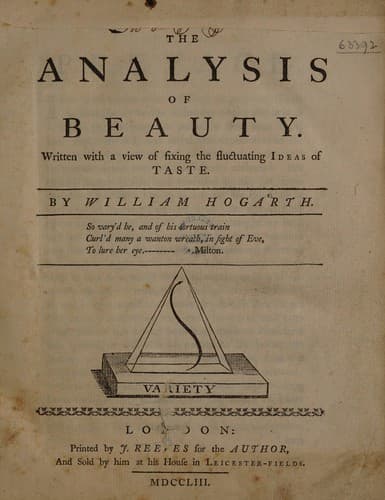
The Analysis of Beauty: Written with a view of fixing the fluctuating ideas of tasteHogarth, William
Philosophy
The Analysis of Beauty: Written with a view of fixing the fluctuating ideas of taste
Hogarth, William
Aesthetics -- Early works to 1800
Fitness of the parts to the design for which every individual thing
is form'd, either by art or nature, is first to be consider'd, as it
is of the greatest consequence to the beauty of the whole. This is so
evident, that even the sense of seeing, the great inlet of beauty,
is itself so strongly bias'd by it, that if the mind, on account of
this kind of value in a form, esteem it beautiful, tho' on all other
considerations it be not so; the eye grows insensible of its want of
beauty, and even begins to be pleas'd, especially after it has been a
considerable time acquainted with it.
It is well known on the other hand, that forms of great elegance often
disgust the eye by being improperly applied. Thus, twisted columns are
undoubtedly ornamental; but as they convey an idea of weakness, they
always displease, when they are improperly made use of as supports to
any thing that is bulky, or appears heavy.
The bulks and proportions of objects are govern'd by fitness and
propriety. It is this that has establish'd the size and proportion of
chairs, tables, and all sorts of utensils and furniture. It is this
that has fix'd the dimensions of pillars, arches, &c. for the support
of great weight, and so regulated all the orders in architecture, as
well as the sizes of windows and doors, &c. Thus though a building were
ever so large, the steps of the stairs, the seats in the windows must
be continued of their usual heights, or they would lose their beauty
with their fitness: and in ship-building the dimensions of every part
are confin'd and regulated by fitness for sailing. When a vessel sails
well, the sailors always call her a beauty; the two ideas have such a
connexion!
The general dimensions of the parts of the human body are adapted thus
to the uses they are design'd for. The trunk is the most capacious on
account of the quantity of its contents, and the thigh is larger than
the leg, because it has both the leg and foot to move, the leg only the
foot, &c.
Fitness of parts also constitutes and distinguishes in a great measure
the characteristics of objects; as for example, the race-horse differs
as much in quality, or character, from the war-horse, as to its figure,
as the Hercules from the Mercury.
The race-horse, having all its parts of such dimensions as best fit the
purposes of speed, acquires on that account a consistent character of
one sort of beauty. To illustrate this, suppose the beautiful head and
gracefully-turn'd neck of the war-horse were placed on the shoulders
of the race-horse, instead of his own aukward straight one: it would
disgust, and deform, instead of adding beauty; because the judgment
would condemn it as unfit.
[Illustration: Fig. 3]
Public-domain text, read in full here on John Shaqi.
Reviews
Reviews
No reviews yet
Be the first to share your thoughts on this work.
Join the Discussion
Join the discussion
Sign in to leave a comment or review.
Sign InorCreate an account