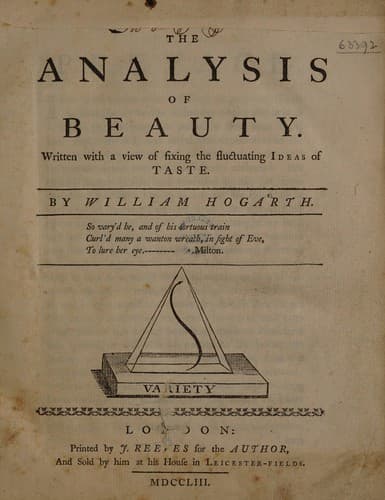
The Analysis of Beauty: Written with a view of fixing the fluctuating ideas of tasteHogarth, William
Philosophy
The Analysis of Beauty: Written with a view of fixing the fluctuating ideas of taste
Hogarth, William
Aesthetics -- Early works to 1800
The Hercules, by Glicon [Fig. 3 p. I], hath all its parts finely fitted
for the purposes of the utmost strength, the texture of the human form
will bear. The back, breast and shoulders have huge bones, and muscles
adequate to the supposed active strength of its upper parts; but as
less strength was required for the lower parts, the judicious sculptor,
contrary to all modern rule of enlarging every part in proportion,
lessen'd the size of the muscles gradually down towards the feet; and
for the same reason made the neck larger in circumference than any
part of the head [Fig. 4 p. I]; otherwise the figure would have been
burden'd with an unnecessary weight, which would have been a draw-back
from his strength, and in consequence of that, from its characteristic
beauty.
[Illustration: Fig. 4]
These seeming faults, which shew the superior anatomical knowledge as
well as judgment of the ancients, are not to be found in the leaden
imitations of it near Hyde-park. These saturnine genius's imagin'd they
knew how to correct such apparent _disproportions_.
These few examples may be sufficient to give an idea of what I mean
(and would have understood) by the beauty of fitness, or propriety.
CHAPTER II.
_Of VARIETY_.
How great a share variety has in producing beauty may be seen in the
ornamental part of nature.
The shapes and colours of plants, flowers, leaves, the paintings in
butterflies wings, shells, &c. seem of little other intended use, than
that of entertaining the eye with the pleasure of variety.
All the senses delight in it, and equally are averse to sameness. The
ear is as much offended with one even continued note, as the eye is
with being fix'd to a point, or to the view of a dead wall.
Yet when the eye is glutted with a succession of variety, it finds
relief in a certain degree of sameness; and even plain space becomes
agreeable, and properly introduced, and contrasted with variety, adds
to it more variety.
I mean here, and every where indeed, a composed variety; for variety
uncomposed, and without design, is confusion and deformity.
Observe, that a gradual lessening is a kind of varying that gives
beauty. The pyramid diminishing from its basis to its point, and the
scroll or voluta, gradually lessening to its center, are beautiful
forms. So also objects that only seem to do so, though in fact they do
not, have equal beauty: thus perspective views, and particularly those
of buildings, are always pleasing to the eye.
Public-domain text, read in full here on John Shaqi.
Reviews
Reviews
No reviews yet
Be the first to share your thoughts on this work.
Join the Discussion
Join the discussion
Sign in to leave a comment or review.
Sign InorCreate an account