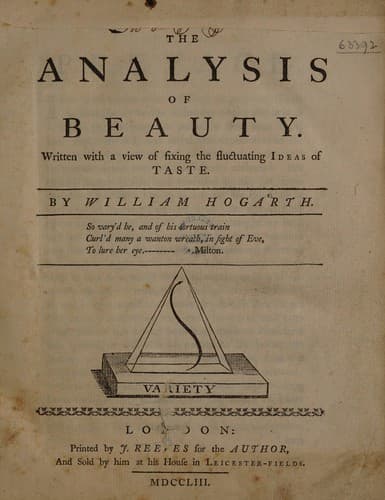
The Analysis of Beauty: Written with a view of fixing the fluctuating ideas of tasteHogarth, William
Philosophy
The Analysis of Beauty: Written with a view of fixing the fluctuating ideas of taste
Hogarth, William
Aesthetics -- Early works to 1800
The little ship, between figure 47 and 88 [p. I], suppos'd moving
along the shore even with the eye, might have its top and bottom
bounded by two lines at equal distances all the way, as A; but if the
ship puts out to sea, these lines at top and bottom would seem to
vary and meet each other by degrees, as B, in the point C, which is
in the line where the sky and water meets, call'd the horizon. Thus
much of the manner of perspectives adding beauty, by seemingly varying
otherwise unvaried forms, I thought, might be acceptable to those, who
have not learnt perspective.
[Illustration: Fig. between Figs. 47 and 88]
CHAPTER III.
_Of UNIFORMITY, REGULARITY, or SYMMETRY_.
It may be imagined that the greatest part of the effects of beauty
results from the symmetry of parts in the object, which is beautiful:
but I am very well persuaded, this prevailing notion will soon appear
to have little or no foundation.
It may indeed have properties of greater consequence, such as
propriety, fitness, and use; and yet but little serve the purposes of
pleasing the eye, merely on the score of beauty.
We have, indeed, in our nature a love of imitation from our infancy,
and the eye is often entertained, as well as surprised, with mimicry,
and delighted with the exactness of counterparts: but then this always
gives way to its superior love of variety, and soon grows tiresom.
If the uniformity of figures, parts, or lines were truly the chief
cause of beauty, the more exactly uniform their appearances were kept,
the more pleasure the eye would receive: but this is so far from being
the case, that when the mind has been once satisfied, that the parts
answer one another, with so exact an uniformity, as to preserve to the
whole the character of fitness to stand, to move, to sink, to swim, to
fly, &c. without losing the balance: the eye is rejoiced to see the
object turn'd, and shifted, so as to vary these uniform appearances.
Thus the profile of most objects, as well as faces, are rather more
pleasing than their full fronts.
Whence it is clear, the pleasure does not arise from seeing the exact
resemblance, which one side bears the other, but from the knowledge
that they do so on account of fitness, with design, and for use. For
when the head of a fine woman is turn'd a little to one side, which
takes off from the exact similarity of the two halves of the face,
and somewhat reclining, so varying still more from the straight and
parallel lines of a formal front face: it is always look'd upon as most
pleasing. This is accordingly said to be a graceful air of the head.
Public-domain text, read in full here on John Shaqi.
Reviews
Reviews
No reviews yet
Be the first to share your thoughts on this work.
Join the Discussion
Join the discussion
Sign in to leave a comment or review.
Sign InorCreate an account