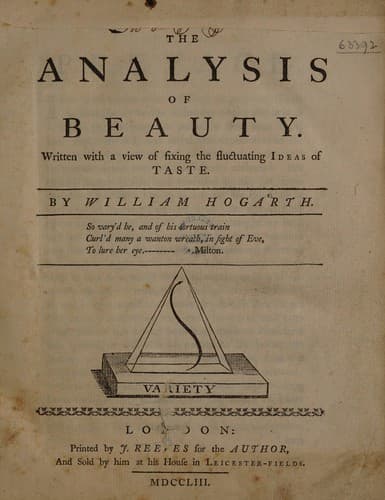
The Analysis of Beauty: Written with a view of fixing the fluctuating ideas of tasteHogarth, William
Philosophy
The Analysis of Beauty: Written with a view of fixing the fluctuating ideas of taste
Hogarth, William
Aesthetics -- Early works to 1800
It is a constant rule in composition in painting to avoid regularity.
When we view a building, or any other object in life, we have it in our
power, by shifting the ground, to take that view of it which pleases
us best; and in consequence of this, the painter if he is left to his
choice, takes it on the angle rather than in front, as most agreeable
to the eye; because the regularity of the lines is taken away by their
running into perspective, without losing the idea of fitness: and when
he is of necessity obliged to give the front of a building, with all
its equalities and parallelisms, he generally breaks (as it is term'd)
such disagreeable appearances, by throwing a tree before it, or the
shadow of an imaginary cloud, or some other object that may answer the
same purpose of adding variety, which is the same with taking away
uniformity.
If uniform objects were agreeable, why is there such care taken to
contrast, and vary all the limbs of a statue?
[Illustration: Figs. 72, 6 and 7]
The picture of Henry the Eighth [Fig. 72 p. II], would be preferable to
the finely contrasted figures of Guido or Correggio; and the Antinous's
easy sway [Fig. 6 p. I], must submit to the stiff and straight figure
of the dancing-master [Fig. 7 p. I]; and the uniform out-lines of the
muscles in the figure [Fig. 55 p. I] taken from Albert Durer's book of
proportions, would have more taste in them than those in the famous
part of an antique figure [Fig. 54 p. I] from which Michael Angelo
acquired so much of his skill in grace.
[Illustration: Figs. 55 and 54]
In short, whatever appears to be fit, and proper to answer great
purposes, ever satisfies the mind, and pleases on that account.
Uniformity is of this kind. We find it necessary, in some degree, to
give the idea of rest and motion, without the possibility of falling.
But when any such purposes can be as well effected by more irregular
parts, the eye is always better pleased on the account of variety.
How pleasingly is the idea of firmness in standing convey'd to the eye
by the three elegant claws of a table, the three feet of a tea-lamp, or
the celebrated tripod of the ancients?
Thus you see regularity, uniformity, or symmetry, please only as they
serve to give the idea of fitness.
CHAPTER IV.
_Of SIMPLICITY, or DISTINCTNESS_.
Simplicity, without variety, is wholly insipid, and at best does only
not displease; but when variety is join'd to it, then it pleases,
because it enhances the pleasure of variety, by giving the eye the
power of enjoying it with ease.
There is no object composed of straight lines, that has so much
variety, with so few parts, as the pyramid: and it is its constantly
varying from its base gradually upwards in every situation of the eye,
(without giving the idea of sameness, as the eye moves round it) that
has made it been esteem'd in all ages, in preference to the cone, which
in all views appears nearly the same, being varied only by light and
shade.
Public-domain text, read in full here on John Shaqi.
Reviews
Reviews
No reviews yet
Be the first to share your thoughts on this work.
Join the Discussion
Join the discussion
Sign in to leave a comment or review.
Sign InorCreate an account