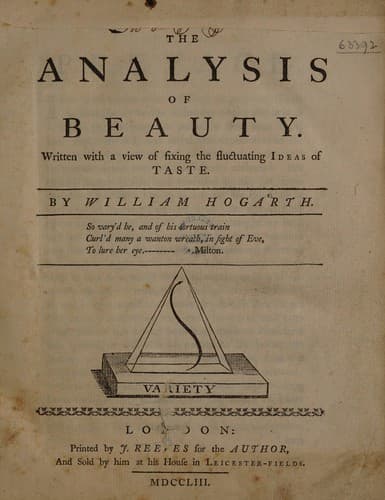
The Analysis of Beauty: Written with a view of fixing the fluctuating ideas of tasteHogarth, William
Philosophy
The Analysis of Beauty: Written with a view of fixing the fluctuating ideas of taste
Hogarth, William
Aesthetics -- Early works to 1800
Steeples, monuments, and most compositions in painting and sculpture,
are kept within the form of the cone or pyramid, as the most eligible
boundary on account of their simplicity and variety. For the same
reason equestrian statues please more than the single figures.
The authors (for there were three concern'd in the work) of as fine
a group of figures in sculpture, as ever was made, either by ancients
or moderns, (I mean Laocoon and his two sons) chose to be guilty of
the absurdity of making the sons of half the father's size, tho' they
have every other mark of being design'd for men, rather than not bring
their composition within the boundary of a pyramid [Fig. 9 T p. I].
Thus if a judicious workman were employ'd to make a case of wood, for
preserving it from the injuries of the weather, or for the convenience
of carriage; he would soon find by his eye, the whole composition would
readily fit and be easily pack'd up, in one of a pyramidal form.
[Illustration: Fig. 9]
Steeples, &c. have generally been varied from the cone, to take
off from their too great simplicity, and instead of their circular
bases, polygons of different, but even numbers of sides, have been
substituted, I suppose for the sake of uniformity. These forms however
may be said to have been chosen by the architect, with a view to the
cone, as the whole compositions might be bounded by it.
Yet, in my mind, odd numbers have the advantage over the even ones,
as variety is more pleasing than uniformity, where the same end
is answer'd by both; as in this case, where both polygons may be
circumscrib'd by the same circle, or in other words, both compositions
bounded by the same cone.
And I can't help observing, that nature in all her works of fancy, if
I may be allow'd the expression, where it seems immaterial whether even
or odd numbers of divisions were prefer'd, most frequently employs the
odd; as for example, in the indenting of leaves, flowers, blossoms, &c.
The oval also, on account of its variety with simplicity, is as much
to be prefer'd to the circle, as the triangle to the square, or the
pyramid to the cube; and this figure lessen'd at one end, like the egg,
thereby being more varied, is singled out by the author of all variety,
to bound the features of a beautiful face.
[Illustration: Fig. 10]
When the oval has a little more of the cone added to it than the egg
has, it becomes more distinctly a compound of those two most simple
varied figures. This is the shape of the pine-apple [Fig. 10 T p. I],
which nature has particularly distinguish'd by bestowing ornaments of
rich mosaic upon it, composed of contrasted serpentine lines, and the
pips [Fig. 11 T p. I], as the gardiners call them, are still varied by
two cavities and one round eminence in each.
[Illustration: Fig. 11]
Public-domain text, read in full here on John Shaqi.
Reviews
Reviews
No reviews yet
Be the first to share your thoughts on this work.
Join the Discussion
Join the discussion
Sign in to leave a comment or review.
Sign InorCreate an account