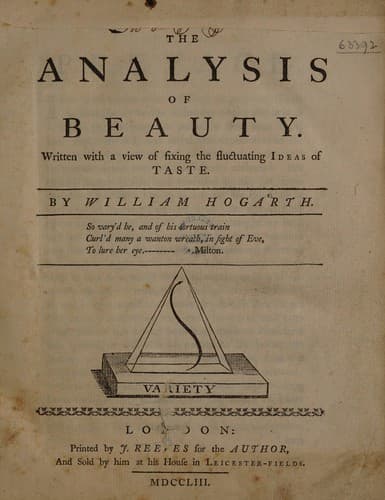
The Analysis of Beauty: Written with a view of fixing the fluctuating ideas of tasteHogarth, William
Philosophy
The Analysis of Beauty: Written with a view of fixing the fluctuating ideas of taste
Hogarth, William
Aesthetics -- Early works to 1800
There are also strong prejudices in favour of straight lines, as
constituting true beauty in the human form, where they never should
appear. A middling connoisseur thinks no profile has beauty without a
very straight nose, and if the forehead be continued straight with it,
he thinks it is still more sublime. I have seen miserable scratches
with the pen, sell at a considerable rate for only having in them a
side face or two, like that between fig. 22, and fig. 105, plate I,
which was made, and any one might do the same, with the eyes shut.
The common notion that a person should be straight as an arrow, and
perfectly erect is of this kind. If a dancing-master were to see his
scholar in the easy and gracefully-turned attitude of the Antinous
(fig. 6, plate I,) he would cry shame on him, and tell him he looked
as crooked as a ram's horn, and bid him hold up his head as he himself
did. See fig. 7, plate I.
[Illustration: Figs. 6 and 7]
The painters, in like manner, by their works, seem to be no less
divided upon the subject than the authors. The French, except such
as have imitated the antique, or the Italian school, seem to have
studiously avoided the serpentine line in all their pictures,
especially Anthony Coypel, history painter, and Rigaud, principal
portrait painter to Lewis the 14th.
Rubens, whose manner of designing was quite original, made use of a
large flowing line as a principle, which runs through all his works,
and gives a noble spirit to them; but he did not seem to be acquainted
with what we call the _precise line_; which hereafter we shall be
very particular upon, and which gives the delicacy we see in the best
Italian masters; but he rather charged his contours in general with too
bold and S-like swellings.
Raphael, from a straight and stiff manner, on a sudden changed his
taste of lines at sight of Michael Angelo's works, and the antique
statues; and so fond was he of the serpentine line, that he carried it
into a ridiculous excess, particularly in his draperies: though his
great observance of nature suffer'd him not long to continue in this
mistake.
Peter de Cortone form'd a fine manner in his draperies of this line.
We see this principle no where better understood than in some pictures
of Corregio, particularly his Juno and Ixion: yet the proportions of
his figures are sometimes such as might be corrected by a common sign
painter.
Whilst Albert Durer, who drew mathematically, never so much as
deviated into grace, which he must sometimes have done in copying the
life, if he had not been fetter'd with his own impracticable rules of
proportion.
Public-domain text, read in full here on John Shaqi.
Reviews
Reviews
No reviews yet
Be the first to share your thoughts on this work.
Join the Discussion
Join the discussion
Sign in to leave a comment or review.
Sign InorCreate an account