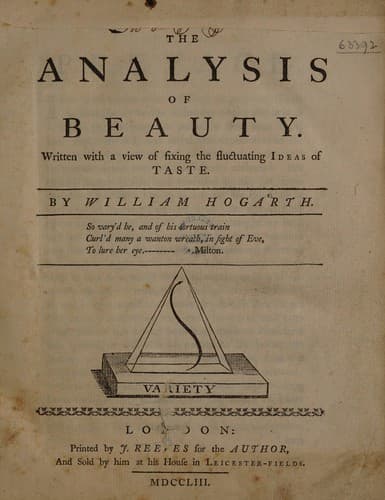
The Analysis of Beauty: Written with a view of fixing the fluctuating ideas of tasteHogarth, William
Philosophy
The Analysis of Beauty: Written with a view of fixing the fluctuating ideas of taste
Hogarth, William
Aesthetics -- Early works to 1800
_Of what sort of PARTS, and how PLEASING FORMS are composed_.
Thus far having endeavoured to open as large an idea as possible of the
power of variety, by having partly shewn that those lines which have
most variety in themselves, contribute most towards the production of
beauty; we will next shew how lines may be put together, so as to make
pleasing figures or compositions.
In order to be as clear as possible, we will give a few examples of
the most familiar and easy sort, and let them serve as a clue to be
pursued in the imagination: I say in the imagination chiefly, for the
following method is not meant always to be put in practice, or follow'd
in every case, for indeed that could hardly be, and in some it would be
ridiculously losing time if it could----Yet there may be cases where
it may be necessary to follow this method minutely; as for example, in
architecture.
I am thoroughly convinc'd in myself, however it may startle some, that
a completely new and harmonious order of architecture in all its parts,
might be produced by the following method of composing, but hardly with
certainty without it; and this I am the more apt to believe, as upon
the strictest examination, those four orders of the ancients, which are
so well established for beauty and true proportion, perfectly agree
with the scheme we shall now lay down.
This way of composing pleasing forms, is to be accomplished by making
choice of variety of lines, as to their shapes and dimensions; and then
again by varying their situations with each other, by all the different
ways that can be conceived: and at the same time (if a solid figure be
the subject of the composition) the contents or space that is to be
inclosed within those lines, must be duly consider'd and vary'd too, as
much as possible, with propriety. In a word, it may be said, the art of
composing well is the art of varying well. It is not expected that this
should at first be perfectly comprehended, yet I believe it will be
made sufficiently clear by the help of the examples following.
[Illustration: Fig. 29]
The figure [Fig. 29 T p. I], represents the simple and pleasing figure
of a bell; this shell, as we may call it, is composed of waving lines,
encompassing, or bounding within it, the varied space marked with
dotted lines: here you see the variety of the space within is equal to
the beauty of its form without, and if the space, or contents, were to
be more varied, the outward form would have still more beauty.
[Illustration: Figs. 30, 31 and 32]
Public-domain text, read in full here on John Shaqi.
Reviews
Reviews
No reviews yet
Be the first to share your thoughts on this work.
Join the Discussion
Join the discussion
Sign in to leave a comment or review.
Sign InorCreate an account