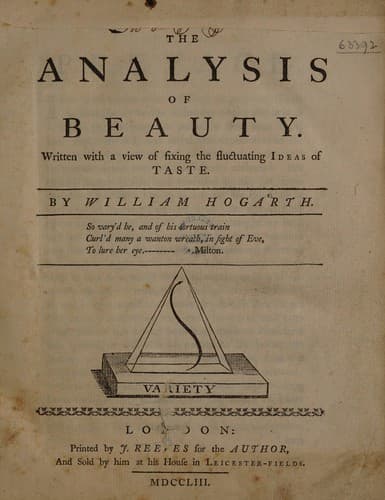
The Analysis of Beauty: Written with a view of fixing the fluctuating ideas of tasteHogarth, William
Philosophy
The Analysis of Beauty: Written with a view of fixing the fluctuating ideas of taste
Hogarth, William
Aesthetics -- Early works to 1800
As a proof, see a composition of more parts, and a way by which those
parts may be put together by a certain method of varying: i. e. how the
one half of the socket of the candlestick A [Fig. 30 T p. I], may be
varied as the other half B. Let a convenient and fit height be first
given for a candlestick, as [Fig. 31 T p. I], then let the necessary
size of the socket be determined, as at (a) [Fig. 32] after which,
in order to give it a better form, let every _distance_ or length of
divisions differ from the length of the socket, as also vary in their
distances from each other, as is seen by the points on the line under
the socket (a); that is let any two points, _signifying distance_, be
plac'd farthest from any other two near points, observing always that
there should be one distance or part larger than all the rest; and you
will readily see that variety could not be so complete without it.--In
like manner, let the horizontal distances (always keeping within the
bounds of fitness) be varied both as to distances and situations, as
on the opposite side of the same figure (b); then unite and join all
the several distances into a complete shell, by applying several parts
of curves and straight lines; varying them also by making them of
different sizes, as (c): and apply them as at (d) in the same figure,
and you have the candlestick [Fig. 33 T p. I], and with still more
variations on the other side. If you divide the candlestick into many
more parts, it will appear crouded, as [Fig. 34 T p. I] it will want
distinctness of form on a near view, and lose the effect of variety at
a distance: this the eye will easily distinguish on removing pretty far
from it.
[Illustration: Figs. 33 and 34]
Simplicity in composition, or distinctness of parts, is ever to be
attended to, as it is one part of beauty, as has been already said: but
that what I mean by distinctness of parts in this place, may be better
understood, it will be proper to explain it by an example.
When you would compose an object of a great variety of parts, let
several of those parts be distinguish'd by themselves, by their
remarkable difference from the next adjoining, so as to make each of
them, as it were, one well-shap'd quantity or part, as is marked by
the dotted lines in figure [35 T p. I] (these are like what they call
passages in music, and in writing paragraphs) by which means, not only
the whole, but even every part, will be better understood by the eye:
for confusion will hereby be avoided when the object is seen near, and
the shapes will seem well varied, tho' fewer in number, at a distance;
as figure [36 p. I] supposed to be the same as the former, but removed
so far off that the eye loses sight of the smaller members.
[Illustration: Figs. 35 and 36]
Public-domain text, read in full here on John Shaqi.
Reviews
Reviews
No reviews yet
Be the first to share your thoughts on this work.
Join the Discussion
Join the discussion
Sign in to leave a comment or review.
Sign InorCreate an account