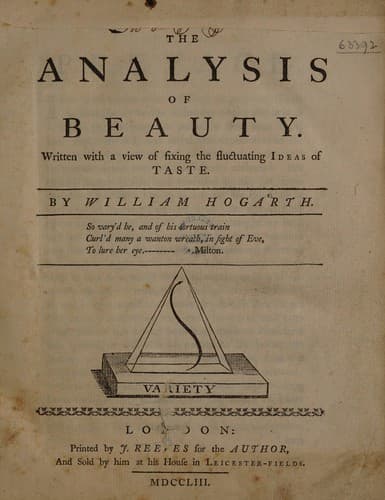
The Analysis of Beauty: Written with a view of fixing the fluctuating ideas of tasteHogarth, William
Philosophy
The Analysis of Beauty: Written with a view of fixing the fluctuating ideas of taste
Hogarth, William
Aesthetics -- Early works to 1800
The parsley-leaf [Fig. 37 T p. I], in like manner, from whence a
beautiful foliage in ornament was originally taken, is divided into
three distinct passages; which are again divided into other odd
numbers; and this method is observ'd, for the generality, in the leaves
of all plants and flowers, the most simple of which are the trefoil and
cinquefoil.
[Illustration: Fig. 37]
Light and shade, and colours, also must have their distinctness to
make objects completely beautiful: but of these in their proper
places----only I will give you a general idea of what is here meant by
the beauty of distinctness of forms, lights, shades, and colours, by
putting you in mind of the reverse effects in all them together.
Observe the well-composed nosegay how it loses all its distinctness
when it dies; each leaf and flower then shrivels and loses its distinct
shape; and the firm colours fade into a kind of sameness: so that the
whole gradually becomes a confused heap.
If the general parts of objects are preserv'd large at first, they will
always admit of farther enrichments of a small kind, but then they must
be so small as not to confound the general masses or quantities.--thus
you see variety is a check upon itself when overdone, which of course
begets what is call'd a _petit taste_ and a confusion to the eye.
[Illustration: Figs. 38 and 39]
It will not be amiss next to shew what effects an object or two
will have that are put together without, or contrary to these rules
of composing variety. Figure [38 L p. I], is taken from one of those
branches fixt to the sides of common old-fashion'd stove-grates by way
of ornament, wherein you see how the parts have been varied by fancy
only, and yet pretty well: close to which [Fig. 39 L p. I] is another,
with about the like number of parts; but as the shapes, neither are
enough varied as to their contents, nor in their situations with each
other, but one shape follows its exact likeness: it is therefore
a disagreeable and tasteless figure, and for the same reason the
candlestick, fig. [40 T p. I] is still worse, as there is less variety
in it. Nay, it would be better to be quite plain, as figure [41 T p.
I], than with such poor attempts at ornament.
[Illustration: Figs. 40, 41 and 42]
Public-domain text, read in full here on John Shaqi.
Reviews
Reviews
No reviews yet
Be the first to share your thoughts on this work.
Join the Discussion
Join the discussion
Sign in to leave a comment or review.
Sign InorCreate an account