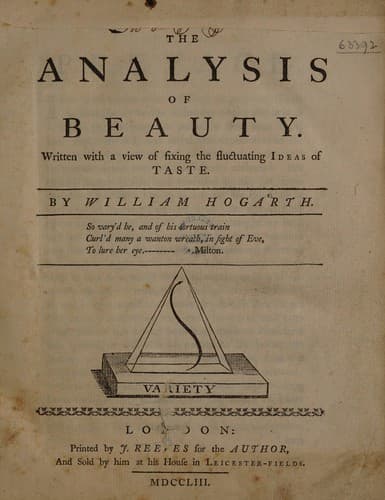
The Analysis of Beauty: Written with a view of fixing the fluctuating ideas of tasteHogarth, William
Philosophy
The Analysis of Beauty: Written with a view of fixing the fluctuating ideas of taste
Hogarth, William
Aesthetics -- Early works to 1800
These few examples, well understood, will, I imagine, be sufficient
to put what was said at the beginning of this chapter out of all
doubt, viz. that _the art of composing well_ is no more than the _art
of varying well_; and to shew, that the method which has been here
explain'd, must consequently produce a pleasing proportion amongst
the parts; as well as that all deviations from it will produce the
contrary. Yet to strengthen this latter assertion, let the following
figures, taken from the life, be examin'd by the above rules for
composing, and it will be found that the Indian-fig or torch-thistle,
figure [42 T p. I], as well as all that tribe of uncouth shaped
exotics, have the same reasons for being ugly, as the candlestick, fig.
40; as also that the beauties of the Lily [Fig. 43 T p. I] and the
calcidonian Iris [Fig. 44 T p. I] proceeds from their being composed
with great variety, and that the loss of variety, to a certain degree,
in the imitations of those flowers underneath them (fig. 45 and 46) is
the cause of the meanness of their shapes, tho' they retain enough to
be call'd by the same names.
[Illustration: Figs. 43 and 44]
[Illustration: Figs. 45 and 46]
Hitherto, with regard to composition, little else but forms made up of
straight and curv'd lines have been spoken of, and though these lines
have but little variety in themselves, yet by reason of the great
diversifications that they are capable of in being join'd with one
another; great variety of beauty of the more useful sort is produced
by them, as in necessary utensils and building: but in my opinion,
buildings as I before hinted, might be much more varied than they are,
for after _fitness_ hath been strictly and mechanically complied with,
any additional ornamental members, or parts, may, by the foregoing
rules, be varied with equal elegance; nor can I help thinking, but that
churches, palaces, hospitals, prisons, common houses and summer houses,
might be built more in distinct characters than they are, by contriving
orders suitable to each; whereas were a modern architect to build a
palace in Lapland, or the West-Indies, Paladio must be his guide, nor
would he dare to stir a step without his book.
Have not many gothic buildings a great deal of consistent beauty
in them? perhaps acquired by a series of improvements made from
time to time by the natural persuasion of the eye, which often very
near answers the end of working by principles; and sometimes begets
them. There is at present such a thirst after variety, that even
paltry imitations of Chinese buildings have a kind of vogue, chiefly
on account of their novelty: but not only these, but any other
new-invented characters of building might be regulated by proper
principles. The mere ornaments of buildings, to be sure, at least might
be allow'd a greater latitude than they are at present; as capitals,
frizes, &c. in order to increase the beauty of variety.
Public-domain text, read in full here on John Shaqi.
Reviews
Reviews
No reviews yet
Be the first to share your thoughts on this work.
Join the Discussion
Join the discussion
Sign in to leave a comment or review.
Sign InorCreate an account