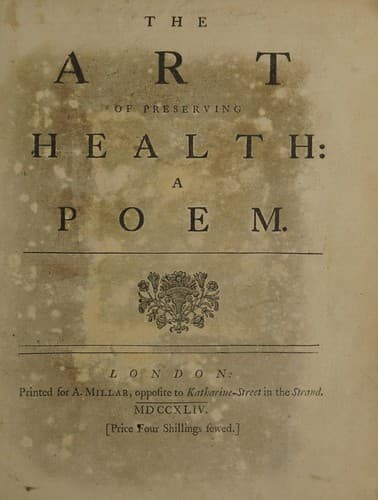
The art of preserving health: A poemArmstrong, John
Philosophy
The art of preserving health: A poem
Armstrong, John
Health -- Early works to 1800; Health -- Poetry; Hygiene -- Early works to 1800; Hygiene -- Poetry
’Tis not for mortals always to be blest. 260
But him the least the dull or painful hours
Of life oppress, whom sober Sense conducts
And Virtue, thro’ this labyrinth we tread.
Virtue and Sense I mean not to disjoin;
Virtue and Sense are one; and, trust me, he 265
Who has not virtue is not truly wise.
Virtue (for meer good-nature is a fool)
Is sense and spirit, with humanity:
’Tis sometimes angry, and its frown confounds;
’Tis even vindictive, but in vengeance just. 270
Knaves fain would laugh at it; some great ones dare;
But at his heart the most undaunted son
Of fortune dreads its name and awful charms.
To noblest uses this determines wealth;
This is the solid pomp of prosperous days; 275
The peace and shelter of adversity.
And if you pant for glory, build your fame
On this foundation, which the secret shock
Defies of Envy and all-sapping Time.
The gawdy gloss of Fortune only strikes 280
The vulgar eye: The suffrage of the wise,
The praise that’s worth ambition, is attain’d
By Sense alone, and dignity of mind.
Virtue, the strength and beauty of the soul,
Is the best gift of heaven: a happiness 285
That even above the smiles and frowns of fate
Exalts great Nature’s favourites: a wealth
That ne’er encumbers, nor to baser hands
Can be transfer’d: it is the only good
Man justly boasts of, or can call his own. 290
Riches are oft by guilt and baseness earn’d;
Or dealt by chance, to shield a lucky knave,
Or throw a cruel sun-shine on a fool.
But for one end, one much-neglected use,
Are riches worth your care: (for Nature’s wants 295
Are few, and without opulence supplied.)
This noble end is, to produce the Soul;
To shew the virtues in their fairest light;
To make Humanity the Minister
Of bounteous Providence; and teach the Breast 300
That generous luxury the Gods enjoy.
Thus, in his graver vein, the friendly Sage
Sometimes declaim’d. Of Right and Wrong he taught
Truths as resin’d as ever Athens heard;
And (strange to tell!) he practis’d what he preach’d. 305
Skill’d in the Passions, how to check their sway
He knew, as far as Reason can controul
The lawless Powers. But other cares are mine:
Form’d in the school of Pæon, I relate
What Passions hurt the body, what improve: 310
Avoid them, or invite them, as you may.
Public-domain text, read in full here on John Shaqi.
Reviews
Reviews
No reviews yet
Be the first to share your thoughts on this work.
Join the Discussion
Join the discussion
Sign in to leave a comment or review.
Sign InorCreate an account