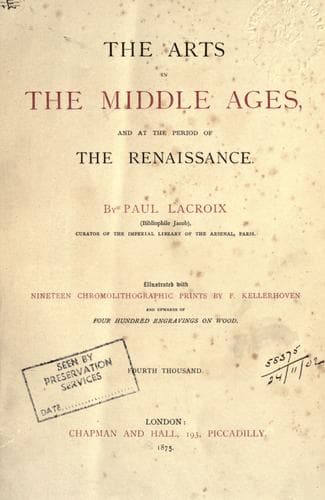
The Arts in the Middle Ages and at the Period of the RenaissanceJacob, P. L.
History
The Arts in the Middle Ages and at the Period of the Renaissance
Jacob, P. L.
Art, Medieval; Art, Renaissance; Middle Ages
If from the dining-room we pass to the kitchen, so as to form some idea
of culinary utensils, we must admit that, anterior to the thirteenth
century, the most circumstantial documents are all but silent on the
subject. Nevertheless, some of the ancient poets and early romancers
allude to those huge mechanical spits on which, at one and the same
time, large joints of different kinds, entire sheep, or long rows of
poultry and game, could be roasted. Moreover, we know that in palaces,
and in the mansions of the nobility, copper cooking-utensils possessed
real importance, because the care and maintenance of the copper-ware was
entrusted to a person who bore the title of _maignen_, a name still
given to the itinerant tinker. We also find that from the twelfth
century there existed the corporation of braziers (_dinans_), who
executed historical designs, in relievo, by the use of the hammer in
beating out and embossing copper,--designs that would bear comparison
with the most elaborate works produced by the goldsmith’s art. Some of
these artisans obtained such reputation that their names have descended
to us. Jean d’Outremeuse, Jean Delamare, Gautier de Coux, Lambert
Patras, were among those who conferred honour on the art of brazier’s
work (_dinanderie_).
From the kitchen to the cellar the distance is usually but short. Our
forefathers, who were large consumers, and in their way had a delicate
appreciation, of the juice of the vine, understood how to store the
barrels which contained their wines in deep and spacious vaults. The
cooper’s art, when almost unknown in Italy and Spain, had existed for a
long time in France, as is attested by a passage taken from the
“Mémoires de l’Académie des Inscriptions:”--“We see by the text of the
Salic law that, when an estate changed hands, the new proprietor gave,
in the first place, a feast, and the guests were bound to eat, in the
presence of witnesses, a plate of boiled minced meat. It is remarked in
the ‘Glossaire de Du Cange’ that, among the Saxons and Flemings, the
word _boden_ means a round table; because the peasantry used the bottom
of a barrel as a table. Tacitus says that for the first meal of the day
the Germans had each their own table; that is to say, apparently a full
or empty barrel placed on end.”
Public-domain text, read in full here on John Shaqi.
Reviews
Reviews
No reviews yet
Be the first to share your thoughts on this work.
Join the Discussion
Join the discussion
Sign in to leave a comment or review.
Sign InorCreate an account