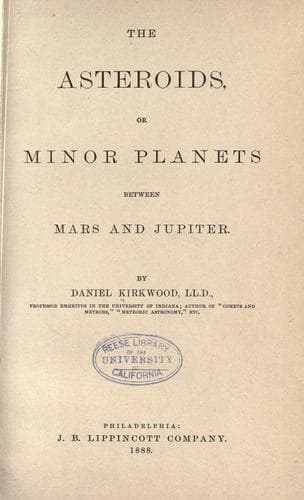
The Asteroids; Or Minor Planets Between Mars and Jupiter.Kirkwood, Daniel
Science
The Asteroids; Or Minor Planets Between Mars and Jupiter.
Kirkwood, Daniel
Asteroids
What was said in regard to the limits of perihelion distance may suggest
a possible answer to these interesting questions. The doctrine of the
sun's gradual contraction is now accepted by a majority of astronomers.
According to this theory the solar radius at an epoch not relatively
remote was twice what it is at present. At anterior stages it was 0.4,
1.0, 2.0,[11] etc. At the first mentioned the comets of 1843 and 1668,
as well as several others, could not have been moving in their present
orbits, since in perihelion they must have plunged into the sun. At the
second, Encke's comet and all others with perihelia within Mercury's
orbit would have shared a similar fate. At the last named all asteroids
with perihelion distances less than two would have been re-incorporated
with the central mass. As the least distance of Æthra is but 1.587, its
orbit could not have had its present form and dimensions when the radius
of the solar nebula was equal to the aphelion distance of Mars (1.665).
It is easy to see, therefore, that in those parts of the ring where
Jupiter would produce extraordinary disturbance the formation of chasms
would be very highly probable.
5. Relations between certain Adjacent Orbits.
The distances, periods, inclinations, and eccentricities of Hilda and
Ismene, the outermost pair of the group, are very nearly identical. It
is a remarkable fact, however, that the longitudes of their perihelia
differ by almost exactly 180°. Did they separate at nearly the same
time from opposite sides of the solar nebula? Other adjacent pairs
having a striking similarity between their orbital elements are Sirona
and Ceres, Fides and Maia, Fortuna and Eurynome, and perhaps a few
others. Such coincidences can hardly be accidental. Original asteroids,
soon after their detachment from the central body, may have been
separated by the sun's unequal attraction on their parts. Such divisions
have occurred in the world of comets, why not also in the cluster of
minor planets?
6. The Eccentricities.
The least eccentric orbit in the group is that of Philomela (196); the
most eccentric that of Æthra (132). Comparing these with the orbit of
the second comet of 1867 we have
The eccentricity of Philomela = 0.01
" " " Æthra = 0.38
" " " Comet II. 1867 (ret. in 1885) = 0.41
The orbit of Æthra, it is seen, more nearly resembles the last than the
first. It might perhaps be called the connecting-link between planetary
and cometary orbits.
Public-domain text, read in full here on John Shaqi.
Reviews
Reviews
No reviews yet
Be the first to share your thoughts on this work.
Join the Discussion
Join the discussion
Sign in to leave a comment or review.
Sign InorCreate an account