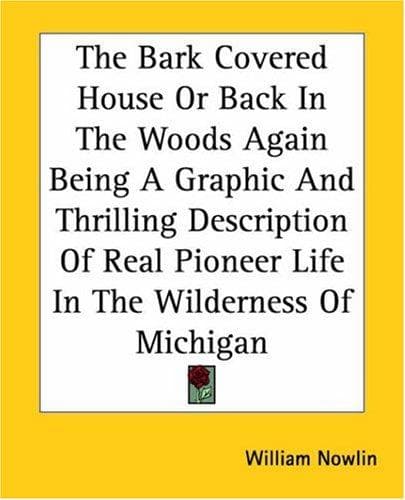
The Bark Covered House: Or, Back In the Woods Again; Being a Graphic and Thrilling Description of Real Pioneer Life in the Wilderness of Michigan — John Shaqi
The Bark Covered House: Or, Back In the Woods Again; Being a Graphic and Thrilling Description of Real Pioneer Life in the Wilderness of MichiganNowlin, William
History
The Bark Covered House: Or, Back In the Woods Again; Being a Graphic and Thrilling Description of Real Pioneer Life in the Wilderness of Michigan
Nowlin, William
Dearborn (Mich.); Frontier and pioneer life -- Michigan -- Dearborn
Father had a good opinion of the Indians, though he had been frightened
by the first one, John Williams, and was afraid of losing his life by
him. He considered him an exception, a wicked, ugly Indian. Thought,
perhaps, he had been driven away from his own tribe, and was like Cain, a
vagabond upon the face of the earth. He was different from other Indians,
as some of them had the most sensitive emotions of humanity. If you did
them a kindness they would never forget it, and they never would betray a
friend; but if you offended them or did them an injury, they would never
forget that either. These two traits of character run parallel with their
lives and only terminate with their existence.
I recollect father's relating a circumstance that happened in the
State of New York, about the time of the Revolutionary War. He said an
Indian went into a tavern and asked the landlord if he would give him
something to eat. The landlord repulsed him with scorn, told him he
wouldn't give him anything and to get out of the house, for he didn't
want a dirty Indian around. There was a gentleman sitting in the room
who saw the Indian come in and heard what was said. The Indian started
to go; the gentleman stepped up and said: "Call him back, give him what
he wants, and I'll pay for it." The Indian went back, had a good meal
and was well used; then he went on his way and the gentleman saw him no
more, at that time.
Shortly after this the gentleman emigrated to the West, and was one of
the advanced guards of civilization. He went into the woods, built him a
house and cleared a piece of land. About this time there was a war in the
country. He was taken captive and carried away a long distance, to an
Indian settlement. He was tried, by them, for his life, condemned to
death and was to be executed the next morning. He was securely bound and
fastened. The chief detailed an Indian who, he thought, knew something of
the whites and their tricks and would be capable of guarding the captive
safely, and he was set as a watch to keep him secure until morning. I
have forgotten what father said was to have been the manner of his
execution; whether he was to be tomahawked or burned, at all events he
was to meet his fate in the morning. Late in the night, after the
warriors were fast asleep and, perhaps, dreaming of their spoils, when
everything was still in the camp, the Indian untied and loosed the
captive, told him to be careful, still, and follow him. After they were
outside the camp, out of hearing, the Indian told the white man that he
was going to save his life and show him the way home. They traveled until
morning and all that day, and the night following, the next morning they
came out in sight of a clearing and the Indian showed him a house and
asked him if he knew the place; he said he did. Then the Indian asked him
if he knew him; he told him that he did not. Then he referred him to the
tavern and asked if he remembered giving an Indian something to eat. He
Public-domain text, read in full here on John Shaqi.
Reviews
Reviews
No reviews yet
Be the first to share your thoughts on this work.
Join the Discussion
Join the discussion
Sign in to leave a comment or review.
Sign InorCreate an account