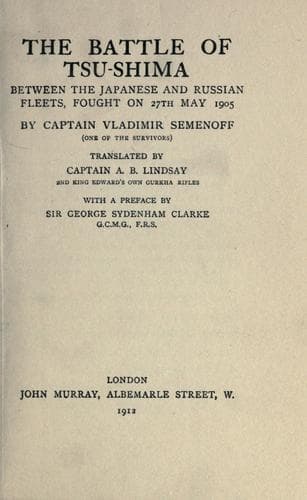
The Battle of Tsu-shima: between the Japanese and Russian fleets, fought on 27th May 1905Semenov, V. I. (Vladimir Ivanovich)
History
The Battle of Tsu-shima: between the Japanese and Russian fleets, fought on 27th May 1905
Semenov, V. I. (Vladimir Ivanovich)
Russo-Japanese War, 1904-1905 -- Naval operations; Tsushima, Battle of, 1905
These were the antecedent technical conditions of a great battle
which, in the startling decisiveness of its results, and in the fact
that the victors lost no ship, challenges comparison with that of the
Nile. The tangled chain of causation now requires to be unravelled
by the coolest heads at our disposal, excluding all previous bias,
and seeking only to apportion the true relative values of the various
factors involved with the single object of securing the sound direction
of future naval policy.
What part did superior speed play in carrying destruction to the
Russian fleet? What guns established the initial superiority of fire
and wrought the havoc, moral and material, which ensured victory? What
purpose did armour serve, and how did its distribution conform to the
needs of the battle? It is upon the answers to such questions as these
that our naval policy must depend.
Underlying the experience of the battle of Tsu-shima there are
undoubtedly principles of general application. It is for us to
ascertain those principles, and to apply them as a test to all ship
designs and tactical theories.
The merit of this little work is that it records the impressions of
a naval officer who apparently had no official duties to absorb his
attention. Captain Semenoff had also the advantage of being present on
board the _Cesarevitch_ at the action of the 10th August 1904, when
it was vital to the Japanese to take no great risks. He significantly
notes the difference of conditions. At Tsu-shima, Admiral Togo was
determined to force a decisive action. Moreover, the Japanese had,
meanwhile, improved their fuses. Thus, in the later action, “shells
seemed to be pouring upon us incessantly.... It seemed as if these were
mines, not shells.... They burst as soon as they touched anything....
No! It was different to the 10th August.”
Incidentally the author notes the “portmanteaus” (Japanese 12-inch
shell) “curving awkwardly head over heels through the air and falling
anyhow on the water.” This shows that some of the Japanese 12-inch
guns--numbering only sixteen--were so much worn as to be unable to give
adequate rotation to their projectiles, which consequently could only
have hit the Russian ships by accident.
The _Suvoroff_, where Captain Semenoff’s experiences were gained,
was a ship of 13,500 tons, with a continuous armour belt 12 feet
broad, tapering in length at the water-line from 8 inches to 6 inches,
and vertically from 6 inches to 4 inches above. Her heavy armament
consisted of four 12-inch guns in 10-inch turrets, standing upon
10-inch barbettes built up from the armoured deck. The secondary
armament of twelve 6-inch guns was mounted in 6-inch turrets standing
upon 6-inch barbettes, all built up from the upper deck. Below the
6-inch barbettes were armoured ammunition hoists carried down to the
belt level. A main armoured deck (3 to 2 inches) at the water-line
level extended all over the ship.
Public-domain text, read in full here on John Shaqi.
Reviews
Reviews
No reviews yet
Be the first to share your thoughts on this work.
Join the Discussion
Join the discussion
Sign in to leave a comment or review.
Sign InorCreate an account