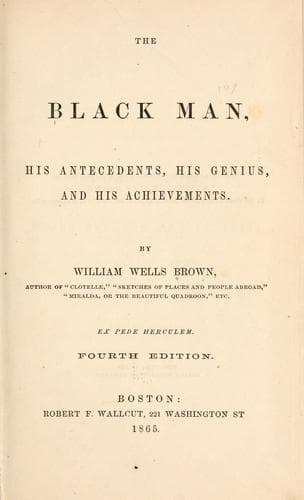
The Black Man: His Antecedents, His Genius, and His Achievements — John Shaqi
The Black Man: His Antecedents, His Genius, and His AchievementsBrown, William Wells
History
The Black Man: His Antecedents, His Genius, and His Achievements
Brown, William Wells
African Americans -- Biography
Nevertheless, the principles of freedom triumphed; not a drop of blood
was shed by the enfranchised blacks; the colonies have arisen from
the blight which they labored under in the time of slavery; the land
has increased in value; and, above all, that which is more valuable
than cotton, sugar, or rice--the moral and intellectual condition of
both blacks and whites is in a better state now than ever before. Sir
William Colebrook, governor of Antigua, said, six years after the
islands were freed, "At the lowest computation, the land, without a
single slave upon it, is fully as valuable now as it was, including
all the slaves, before emancipation." In a report made to the British
Parliament, in 1859, it was stated that three fifths of the cultivated
land of Jamaica was the _bona fide_ property of the blacks. The land is
in a better state of cultivation now than it was while slavery existed,
and both imports and exports show a great increase. Every thing
demonstrates that emancipation in the West India islands has resulted
in the most satisfactory manner, and fulfilled the expectation of the
friends of freedom throughout the world.
Rev. Mr. Underhill, secretary of the English Baptist Missionary
Society, who has visited Jamaica, and carefully studied its condition,
said, in a recent speech in London, that the late slaves in that island
had built some two hundred and twenty chapels. The churches that
worship in them number fifty-three thousand communicants, amounting
to one eighth of the total population. The average attendance, in
other than the state churches, is ninety-one thousand--a fourth of the
population. One third of the children--twenty-two thousand--are in the
schools. The blacks voluntarily contribute twenty-two thousand pounds
(one hundred and ten thousand dollars) annually for religious purposes.
Their landed property exceeds five million dollars. Valuing their
cottages at only fifty dollars each, these amount to three million
dollars. They have nearly three hundred thousand dollars deposited in
the savings banks. The sum total of their property is much above eleven
million dollars. All this has been accumulated since their emancipation.
Thus it is seen that all parties have been benefited by the abolition
of negro slavery in the British possessions. Now we turn to our
own land. Among the many obstacles which have been brought to bear
against emancipation, one of the most formidable has been the series
of objections urged against it upon what has been supposed to be the
slave's want of appreciation of liberty, and his ability to provide for
himself in a state of freedom; and now that slavery seems to be near
its end, these objections are multiplying, and the cry is heard all
over the land, "What shall be done with the slave if freed?"
Public-domain text, read in full here on John Shaqi.
Reviews
Reviews
No reviews yet
Be the first to share your thoughts on this work.
Join the Discussion
Join the discussion
Sign in to leave a comment or review.
Sign InorCreate an account