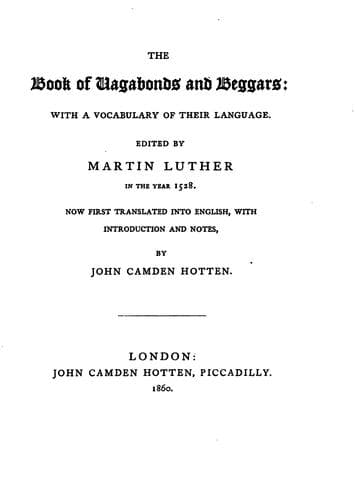
The Book of Vagabonds and Beggars, with a Vocabulary of Their Language
History
The Book of Vagabonds and Beggars, with a Vocabulary of Their Language
Begging -- Germany; German language -- Slang; Wayfaring life -- Germany
I need scarcely remark that a seal in those days, when but few public
functionaries could write, was looked upon as the badge of authority
and genuineness, and that as the art of writing became more general
autograph signatures supplanted seals. An English vagabond in the time
of Elizabeth, when speaking of his passport, called it his JARKE, or
JARKEMAN, viz. his sealed paper. His descendant of the present century
would term it his LINES, viz. his written paper. The cant term JARKE
is almost obsolete, but the powerful magic of a big seal is still
remembered and made use of by the tribe of cadgers. When a number of
them at the present day wait upon a farmer with a fictitious paper,
authorizing them to collect subscriptions for the sufferers in some
dreadful colliery accident, the document, covered with apparently
genuine signatures, is generally garnished with a huge seal.
In Germany it was the custom (alluded to at page 34) for the priests
or clerks to read these licenses to beg from the pulpit, that the
congregation might know which of the poor people who waited at
their doors were worthy of alms. Sometimes, as in the case of the
DÜTZBETTERIN, or false “lying-in-woman,” an anecdote of whom
is told here, the priests were deceived by counterfeit documents.
At page 17 reference is made to the wandering students who used
to trudge over the country and sojourn for a time at any school
charitable enough to take them in. These, in their journeys, often
fell in with rogues and tramps, and sometimes joined them in their
vagabond calling, in which case they obtained for themselves the
title of KAMMESIERERS, or “Learned Beggars.” Now these same
vagabond scholars were to be met with in this country in the time of
Henry VIII,—and in Ireland, I believe, so late as the last century.
Examining again the Act for Vagrants, 1531, we find that it was usual
and customary for poor scholars from Oxford and Cambridge to tramp from
county to county. The statute provided them with a document, signed
by the commissary, chancellor, or vice-chancellor, which acted as
their passport. When found without this license they were treated as
vagrants, and whipped accordingly.
It is remarkable that many of the tricks and manœuvres to obtain money
from the unthinking but benevolent people of Luther’s time should have
been practised in this country at an early date, and that they should
still be found amongst the arts to deceive thoughtless persons adopted
by rogues and tramps at the present day. The stroller, or “Master of
the Black Art,” described at page 19, is yet occasionally heard of
in our rural districts. The simple farmer believes him to be weather
and cattle wise, and should his crops be backward, or his cow “Spot,”
not “let down her milk,” with her accustomed readiness, he crosses
the fellow’s hand with a piece of silver, in order that things may be
righted.
Public-domain text, read in full here on John Shaqi.
Reviews
Reviews
No reviews yet
Be the first to share your thoughts on this work.
Join the Discussion
Join the discussion
Sign in to leave a comment or review.
Sign InorCreate an account