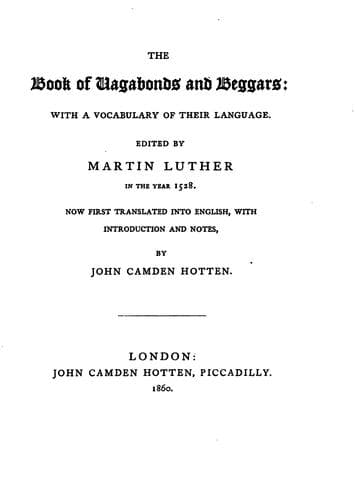
The Book of Vagabonds and Beggars, with a Vocabulary of Their Language
History
The Book of Vagabonds and Beggars, with a Vocabulary of Their Language
Begging -- Germany; German language -- Slang; Wayfaring life -- Germany
Some have conjectured that it was an original compilation by Audley,
the printer; but this little book, perhaps more than Harman’s, shows
traces of the German work. The “XXV Orders of Knaues” is nearly
the number described in the _Liber Vagatorum_, and the tricks, and
description of beggars’ dresses in both are very similar. There are the
rogues with patched cloaks, who begged with their wives and “doxies;”
those with forged licenses and letters, who pretended to collect for
hospitals; those afflicted with the falling sickness, a numerous
number; some without tongues, carrying letters, pretending they have
been signed and sealed by the authorities of the towns from whence
they came; others, “freshe-water mariners,” with tales of a dreadful
shipwreck, and many more, all described in similar words, whether in
the pages of the _Liber Vagatorum_, Harman, or Audley. It is reasonable
to suppose, therefore, that the German account, being in the hands of
the people abroad half a century before anything of the kind was issued
here, copies must have found their way to England, and that from these
the other two were in a great measure derived.
I might remark that other accounts of English vagabonds were published
soon after this. The subject had become popular, and a demand for books
of the kind was the result. Harrison, who wrote the _Description of
England_, prefixed to _Holinshed’s Chronicle_ (1577), describes the
different orders of beggars. Greene, about 1592, wrote several works,
based mainly on old Harman’s book; and Decker, twenty years later,
provided a similar batch, giving an account of the vagabonds and loose
characters of his day.
Shakespeare, too, and other dramatists of the period, introduced
beggars and mendicants into their plays in company with the Gipsies,
with whom, in a great measure, in this country they were allied.
Amongst those passages which refer to the customs and tricks of
beggars, in the _Liber Vagatorum_, there are few which receive
illustration by a reference to the early laws and statutes of this
country.
The licenses, or “letters with seals,” so frequently alluded to, and
which were granted to deserving poor people by the civil authorities,
are mentioned as customary in this country in the Act for the ordering
of Vagrants, passed in the reign of Henry VIII. (1531). It appears that
the parish officers were compelled by this statute to make inquiry into
the condition of the poor, and to ascertain who were really impotent
and who were impostors. To a person actually in want liberty was
given to beg within a certain district, “and further,” says the Act,
“there shall be delivered to every such person a letter containing
the name of that person, witnessing that he is authorized to beg, and
the limits within which he is appointed to beg, the same letter to be
sealed with the seal of the hundred, rape, wapentake, city, or borough,
and subscribed with the name of one of the said justices or officers
aforesaid.”
Public-domain text, read in full here on John Shaqi.
Reviews
Reviews
No reviews yet
Be the first to share your thoughts on this work.
Join the Discussion
Join the discussion
Sign in to leave a comment or review.
Sign InorCreate an account