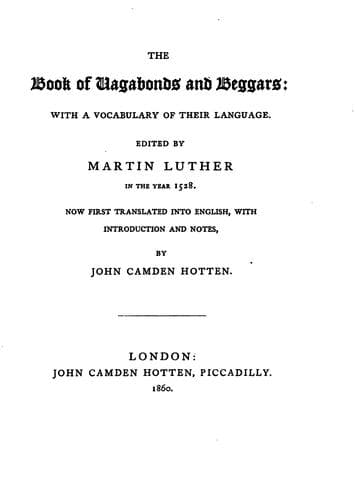
The Book of Vagabonds and Beggars, with a Vocabulary of Their Language
History
The Book of Vagabonds and Beggars, with a Vocabulary of Their Language
Begging -- Germany; German language -- Slang; Wayfaring life -- Germany
In Schreiber’s account of the _Bettler-industrie_ (begging practices)
of Germany in the year 1475, he thus speaks of this golden age for
mendicants.[1] His theory, as to the origin of the complicated system
of mendicity, is, perhaps, more fanciful than true, but his account is
nevertheless very interesting, and well worth extracting from.
“The beggars of Germany rejoiced in their Golden Age; it extended
throughout nearly two centuries, from the invasions of the Turks until
after the conclusion of the Swedish war (1450 to 1650). During this
long period it was frequently the case that begging was practised less
from necessity than for pleasure;—indeed, it was pursued like a regular
calling. For poetry had estranged herself from the Nobility; knights
no longer went out on adventures to seek giants and dragons, or to
liberate the Holy Tomb; she had likewise become more and more alien to
the Citizen, since he considered it unwise to brood over verses and
rhymes, when he was called upon to calculate his profits in hard coin.
Even the ‘Sons of the Muses,’ the Scholars, had become more prosaic,
since there was so much to learn and so many universities to visit, and
the masters could no longer wander from one country to another with
thousands of pupils.
“Then poetry (as everything in human life gradually descends) began
to ally herself with beggars and vagrants. That which formerly had
been misfortune and misery became soon a sort of free art, which only
retained the mask of misery in order to pursue its course more safely
and undisturbed. Mendicity became a distinct institution, was divided
into various branches, and was provided with a language of its own.
Doubtless, besides the frequent wars, it was the Gipsies—appearing in
Germany, at the beginning of the fifteenth century, in larger swarms
than ever—who contributed greatly to this state of things. They formed
entire tribes of wanderers, as free as the birds in the air, now
dispersing themselves, now reuniting, resting whereever forests or
moors pleased, or stupidity and superstition allured them, possessing
nothing, but appropriating to themselves the property of everybody, by
stratagem or rude force.
“In what manner and to what extent such beggary had grown up and
branched off towards the close of the fifteenth century, what
artifices and even what language these beggars used to employ, is shown
us in Johann Knebel’s Chronicles, the MSS. of which are preserved in
the Library of the City and University of Bâle.”
Public-domain text, read in full here on John Shaqi.
Reviews
Reviews
No reviews yet
Be the first to share your thoughts on this work.
Join the Discussion
Join the discussion
Sign in to leave a comment or review.
Sign InorCreate an account