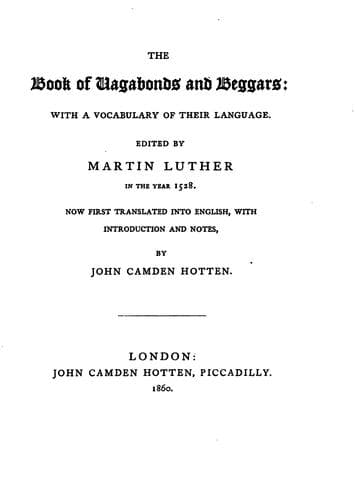
The Book of Vagabonds and Beggars, with a Vocabulary of Their Language
History
The Book of Vagabonds and Beggars, with a Vocabulary of Their Language
Begging -- Germany; German language -- Slang; Wayfaring life -- Germany
These MSS. are very curious. They contain the proceedings of the Trials
at Basle,[2] in Switzerland, in 1475, when a great number of vagabonds,
strollers, blind men, and mendicants of all orders, were arrested and
examined. Johann Knebel was the chaplain of the cathedral there, and
wrote them down at the time. From the reports of these trials it is
believed the _Liber Vagatorum_ was compiled; and it is also conjectured
that, from the same rich source, Sebastian Brant, who just at that
period had established himself at the University of Basle, where he
remained until 1500, drew the vivid description of beggars and begging,
to be found in his _Ship of Fools_.[3]
Knebel gives a long list of the different orders of beggars, and the
names they were known by amongst themselves. This account is similar
to, only not so spirited as that given in the _Liber Vagatorum_. The
tricks and impostures are very nearly the same, together with the
cant terms for the various tribes of mendicants. Knebel, speaking of
the manner in which the tricks of these rogues were first found out,
says:—“At those times a great number of knaves went about the country
begging and annoying people. Of these several were caught, and they
told how they and their fellow-knaves were known, and when and how they
used to meet, what they were called, and they told also several of
their cant words.”
The _Liber Vagatorum_, or _The Book of Vagabonds_, was probably written
shortly after 1509, that year being mentioned in the work; it is the
earliest book on beggars and their secret language of which we have any
record,—preceding by half a century any similar work issued in this
country.
Nothing is known of the author other than that it was written by
one who styled himself a “Reverend Magister, nomine expertus in
truffis,”—which proficiency in roguery, as Luther remarks, “the little
book very well proves, even though he had not given himself such a
name.”
None of the early impressions bears a date, but the first edition is
known to have been printed at Augsburg, about the year 1512-14, by
Erhart Öglin, or Ocellus.[4] It is a small quarto, consisting of 12
leaves.
The title:—
+Liber Vagatorum;
Der Betler Orden:+
Public-domain text, read in full here on John Shaqi.
Reviews
Reviews
No reviews yet
Be the first to share your thoughts on this work.
Join the Discussion
Join the discussion
Sign in to leave a comment or review.
Sign InorCreate an account