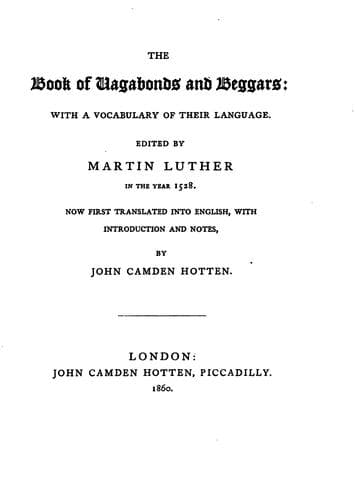
The Book of Vagabonds and Beggars, with a Vocabulary of Their Language — John Shaqi
The Book of Vagabonds and Beggars, with a Vocabulary of Their Language
History
The Book of Vagabonds and Beggars, with a Vocabulary of Their Language
Begging -- Germany; German language -- Slang; Wayfaring life -- Germany
_GLESTERICH_, glass. _German_, GLITZERN, to glitter.
_GLID_ (_i.e._ GLEID), a harlot.
_GLIDENBOSS_, a brothel.
_GLIDENFETZERIN_, a frequenter of brothels.
_GLISS_, milk.
_GOFFEN_, SCHLAHEN.
_GRIFFLING_, a finger. _German_, GREIFEN, to grasp.
_GRIN_ (_i.e._ GRYM[19]), food.
_GRUNHART_, a field, _i.e._ very green, or green-like.
_GUGELFRANZ_, a monk.
_GUGELFRENZIN_, a nun.
_GURGELN_, LANTSKNECHTBETLIN, _i.e._ GURGELN LANTSKNECHT, would
seem to refer to a begging foot-soldier.
_HANFSTAUD_, a shirt,—literally “hemp-shrub.”
_HANS WALTER_, a louse. HANZ literally means Jack or John. The old
word HANSA refers to a multitude; _Old German_, HANSE, a society;
HANS, a companion.
_HANS VON GELLER_, coarse bread.
_HAR_, FLEUCH.
_HANZ_, a peasant. _See_ HANS WALTER.
_HANZIN_, a peasant’s wife.
_HEGIS_, a hospital. The _Old German_, HAG, is a house (from HAGEN
to hedge in, inclose), _quasi locus septus habitandi causa_. The
_Old German_, HEGEN, is to nourish, feed, to receive into one’s
house and company. The _Su. Goth._ HÆGA, is to serve.
_HELLERICHTIGER_, a florin.
_HERTERICH_, a knife or dagger.
_HIMMELSTEIG_, the Lord’s Prayer,—literally, “Heaven’s steps.”
_HOCKEN_, to sit, to lie.
_HOLDERKAUZ_, a hen.
_HORK_, a peasant.
_HORNBOCK_, a cow.
_ILTIS_, a constable, town sergeant. The _Modern German_, ILTISS,
or ILTIS, signifies a pole-cat, fitchet; and ILTISFALLE is a trap
for catching pole-cats,—or, as Dr. Johnson calls them, “stinking
beasts.” The _Icelandic_, ILLTUR, is _malus_; and the _Cymrie_,
YLLTYR, is _talpa_, a mole.
_JOHAM_, wine. From the _Hebrew_, YAH’-YIN, wine. Gengenbach
renders this JOHIN.
_JONEN_, to play,—at cards, or other game of chance. _French_,
JOUER?
_JONER_, a player, a gambler.
_JUFFART_, DER DA ROT IST ODER FREIHEIT.
_JUVERBASSEN_, to swear.
_KABAS_, a head. _Latin_, caput.
_KAFFRIM_ (JACOBSBRÜDER), a pilgrim to the grave of St. James.
_KAMMESIERER_, a learned beggar.
_CAVAL_, a horse. _Latin_, CABALLUS.
_CAVELLER_, a slayer, a butcher. _Modern German_, KAFILLER.
_KERIS_, wine. _Modern German_, XERESWEIN, sherry;
or, from KIRSCHE, a cherry,—KIRSCHEN-WASSER, cherry-water.
_CHRISTIAN_ (JACOBSBRÜDER), a pilgrim to the grave of St.
James.
_KIELAM_, a town.
_KIMMERN_, to buy. _German_, KRAMEN, to trade.
_CLAFFOT_, a dress, a cloak. In Gengenbach’s metrical version of
the _Liber Vagatorum_, this is rendered KLABOT, Clothes.
_CLAFFOT-FETZER_, a tailor.
_KLEBIS_, a horse,—literally, “a clover-biter.”
_KLEMS_, punishment, imprisonment. The _German_, KLEMMEN, signifies
to pinch.
_KLEMSEN_, to arrest, imprison.
_KLENKSTEIN_, a traitor.
_KLINGEN_, LEIER;—perhaps one who plays upon a lyre, from the
_German_, KLINGEN, to sound, KLINGELN, to tinkle.
_KLINGENFETZERIN_, LEIERIN,—probably a female player upon
the lyre.
Public-domain text, read in full here on John Shaqi.
Reviews
Reviews
No reviews yet
Be the first to share your thoughts on this work.
Join the Discussion
Join the discussion
Sign in to leave a comment or review.
Sign InorCreate an account