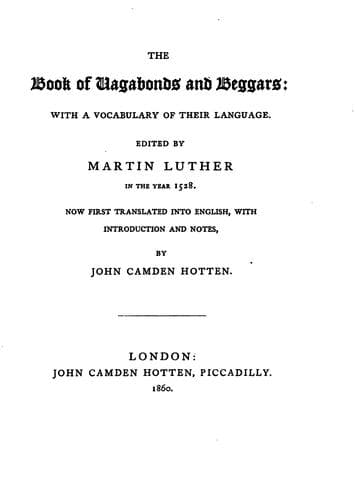
The Book of Vagabonds and Beggars, with a Vocabulary of Their Language
History
The Book of Vagabonds and Beggars, with a Vocabulary of Their Language
Begging -- Germany; German language -- Slang; Wayfaring life -- Germany
_SCHOSA_, _vulva_. This is supposed to be from the _Silesian_,
DIE SCHOOS, the lap; _Bavarian_, GSCHOSL.
_SCHREF_, a harlot.
_SCHREFENBOSS_, a house of ill fame.
_SCHREILING_, a child,—diminutive formed from SCHREIEN, to
cry.
_SCHRENZ_, a room.
_SCHÜRNBRANT_, beer.
_SCHWENZEN_, to go.
_SCHWERZ_, night. _German_, SCHWARZ, black.
_SEFEL_, dirt. _Hebrew_, SHÁFÁR, humble, mean?
_SEFELBOSS_, a house of office, dirt-house.
_SEFELN_, to evacuate.
_SENFTRICH_, a bed. _German_, SANFT, soft.
_SONNENBOSS_, a brothel.
_SONZ_, a nobleman, gentleman.
_SONZIN_, a lady.
_SPELTING_, a heller,—the smallest coin.
_SPITZLING_, oats. _Modern German_, SPITZLING, oat-grass; SPITZE,
the point of anything; SPITZ, pointed, peaked. The term appears to
be a diminutive.
_SPRANKART_, salt. _German_, SPRENKELN, to scatter.
_STABULER_, a bread-gatherer.
_STEFUNG_, ZIL. _Old German_, ZIL, is _finis_, _limes_, _terminus
temporis et loci_; also _meta jaculantis_, _scopus agentis_,
_terminus oculi et mentis_.
_STETTINGER_, a florin,—perhaps one minted at Stettin.
_STOLFEN_, to stand.
_STREIFLING_, trousers. _German_, STREIFEN, to strip.
_STROBORER_, a goose,—literally, “a straw-borer.”
_STROM_, a brothel. Possibly an allusion to STRUMMEL, the _Old
English Cant_ for straw, with which houses of this description may
have been littered. The cant expression, STRUMMEL, was probably
introduced into this country by the gipsies and other vagabonds
from the Continent, in the reign of Henry VIII.
_STROMBART_, a forest.
_STUPART_, flour. _Old German_, STOPPEL, _cauda frumenti_,
from the _Latin_, STIPULA.
_TERICH_, the land, or country. _Latin_, TERRA.
_VERKIMMERN_, to sell. _See_ KIMMERN.
_VERLUNSCHEN_, VERSTEEN.
_VERMONEN_, to cheat.
_VERSENKEN_, to pawn,—literally, “to sink.”
_VOPPART_, a fool. _Modern German_, FOPPEN, to mock.
_VOPPEN_, to lie, tell falsehoods.
_WENDERICH_, cheese.
_WETTERHAN_, a hat,—literally, “a weathercock.”
_WINTFANG_, a cloak,—literally, “a wind-catcher.”
_WISSULM_, silly people.
_WUNNENBERG_, a pretty young woman. _German_, WONNE,
pleasure.
_ZICKUS_, a blind man. _Latin_, CÆCUS.
_ZWENGERING_, a jacket. _German_, ZWÄNGEN, to force.
_ZWICKER_, a hangman. _German_, ZWICKEN, to pinch.
_ZWIRLING_, an eye.
NOTHING WITHOUT REASON.
FOOTNOTES:
[1] _Taschenbuch für Geschichte und Alterthum in Sud-Deutschland, von
Heinrich Schreiber_, Fribourg, 1839, p. 333. The Basle MSS. are here
reprinted without any alteration.
[2] These Trials are also recorded in an old MS. of _Hieron. Wilh.
Ebner_, printed in _Joh. Heumanni Exercitationes iuris universi_, vol.
I. (Altdorfi, 1749, 4^o.) No. XIII. Observatio de lingua occulta, pp.
174-180. Both Knebel and Ebner’s accounts differ merely in style and
dialect; in all essential points they closely harmonize.
Public-domain text, read in full here on John Shaqi.
Reviews
Reviews
No reviews yet
Be the first to share your thoughts on this work.
Join the Discussion
Join the discussion
Sign in to leave a comment or review.
Sign InorCreate an account