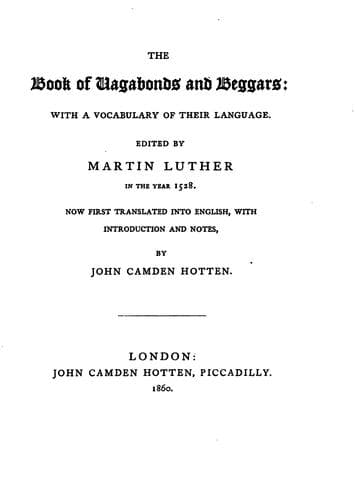
The Book of Vagabonds and Beggars, with a Vocabulary of Their Language
History
The Book of Vagabonds and Beggars, with a Vocabulary of Their Language
Begging -- Germany; German language -- Slang; Wayfaring life -- Germany
is printed in red. The title-page of this, as of most of the early
editions, is embellished with a woodcut,—a facsimile of which is
given in this translation. The picture, representing a beggar and
his family, explains itself. At the foot of the title is printed, in
black:—_Getrucht zu Augspurg durch Erhart Öglin_. The little book
was frequently reprinted without any other variations than printers’
blunders (one edition having an error in the first word, _Lieber
Vagatorum_) until 1528, when Luther edited an edition,[5] supplying a
preface, and correcting some of the passages. In 1529 another edition,
with Luther’s preface, appeared at Wittemberg,[6] and from this,
comparing it occasionally with the first edition by Ocellus, the
present English version has been made. Nearly all the editions contain
the same matter; nor do those issued under Luther’s authority furnish
us with additional information. With regard to the Vocabulary, however,
I have made, in a few instances, slight variations, as given in two
editions of the _Liber Vagatorum_, preserved in the Library at Munich.
Wherever there was a marked divergence in style I have adopted that as
my text which seemed to be the most characteristic for the fifteenth
and the commencement of the sixteenth centuries, and which is mostly to
be found in the better class MSS. and works of that period.
I should state, however, before proceeding further, that a metrical
version of the _Liber Vagatorum_, in 838 verses, appeared about
1517-18, written by Pamphilus Gengenbach, including a vocabulary of the
beggars’ cant. Although Karl Gödecke, in his work, _Ein Beitrag zur
Deutschen Literatur Geschichte der Reformations zeit_ (Hannover, Carl
Rümpler, 1855), has stated that Gengenbach’s poetical version preceded
the smaller prose account, it is impossible, upon examining the two
publications, to agree with him on this point. Gengenbach’s book
certainly did not appear till after 1517, and the direct copies from
the _Liber Vagatorum_, in matter and manner, are too frequent to admit
for one moment of the supposition of their being accidental. The cant
terms, too, are incorrectly given, and altogether the work bears the
appearance of hasty and piratical compilation. It never met with that
popularity which the author anticipated, and probably never crossed the
frontiers of Switzerland.
The latest prose edition of the _Liber Vagatorum_ was issued towards
the close of the seventeenth century. The title ran:—_Expertus in
truffis. Of False Beggars and their knaveries. A pretty little book,
made more than a century and a half since, together with a Vocabulary
of some old cant words that occur therein, newly edited._ Anno 1668
(12^o. pp. 160).
Public-domain text, read in full here on John Shaqi.
Reviews
Reviews
No reviews yet
Be the first to share your thoughts on this work.
Join the Discussion
Join the discussion
Sign in to leave a comment or review.
Sign InorCreate an account