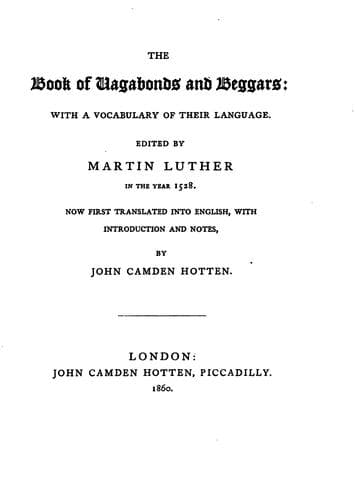
The Book of Vagabonds and Beggars, with a Vocabulary of Their Language
History
The Book of Vagabonds and Beggars, with a Vocabulary of Their Language
Begging -- Germany; German language -- Slang; Wayfaring life -- Germany
That Luther should have written a Preface to so undignified a
little work as _The Book of Vagabonds_ seems remarkable. At this
period (1528-9) he was in the midst of his labours, surrounded with
difficulties and cares, and with every moment of his time fully
occupied. The Protest of Spires had just been signed by the first
Protestants. Melancthon, in great affliction at the turbulent state of
affairs, was running from city to city; and all Germany was alarmed
to hear that the dreaded Turks were preparing to make battle before
Vienna. Yet, the centre of all this agitation, engaged in directing and
assisting his followers, Luther found time to write several popular
pieces, and kept, we are told, the book-hawkers of Augsburg and Spires
busy in supplying them to the people. These Christian pamphlets,
D’Aubigné informs us, were eagerly sought for and passed through
numberless editions. It was not the peasants and townspeople only who
read them, but nobles and princes. Luther intended that they should
be popular. He knew better than any man of his time how to captivate
the reader and fix his attention. His little books were short, easy to
read, full of homely sayings and current phrases, and ornamented with
curious engravings. They were generally written, too, in Latin and
German, to suit both the educated and the unlettered. One was entitled,
_The Papacy with its Members painted and described by Dr. Luther_. In
it figured the Pope, the cardinal, and all the religious orders. Under
the picture of one of the orders were these lines:—
“We can fast and pray the harder,
With an overflowing larder.”
“Not one of these orders,” said Luther to the reader, “thinks either
of faith or charity. This one wears the tonsure, the other a hood,
this a cloak, that a robe. One is white, another black, a third gray,
and a fourth blue. Here is one holding a looking-glass, there one with
a pair of scissors. Each has his playthings.... Ah! these are the
palmer-worms, the locusts, the canker-worms, and the caterpillars
which, as Joel saith, have eaten up all the earth.”[7]
In this style Luther addressed his readers—scourging the Pope, his
cardinals, and all their emissaries. But another class of “locusts”
besides these appeared to him to require sweeping away,—these were the
beggars and vagabonds who imitated the Mendicant Friars in wandering
up and down the country, with lying tales of distress, either of
mind or body. As he says in his Preface, explaining the reason of
his connection with the book, “I thought it a good thing that such a
work should not only be published, but that it should become known
everywhere, in order that men can see and understand how mightily the
devil rules in this world; and I have also thought how such a book may
help mankind to be wise, and on the look out for him, viz. the devil.”
Public-domain text, read in full here on John Shaqi.
Reviews
Reviews
No reviews yet
Be the first to share your thoughts on this work.
Join the Discussion
Join the discussion
Sign in to leave a comment or review.
Sign InorCreate an account