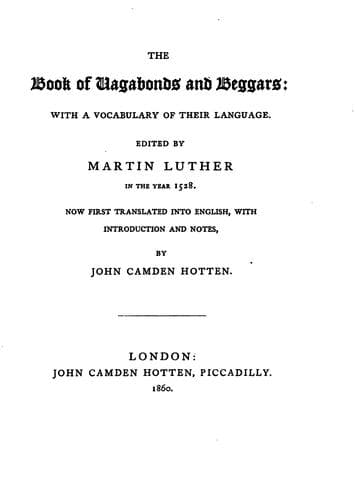
The Book of Vagabonds and Beggars, with a Vocabulary of Their Language — John Shaqi
The Book of Vagabonds and Beggars, with a Vocabulary of Their Language
History
The Book of Vagabonds and Beggars, with a Vocabulary of Their Language
Begging -- Germany; German language -- Slang; Wayfaring life -- Germany
Luther further adds—not forgetting, in passing, to give a blow to
Papacy—“Princes, lords, counsellors of state, and everybody should
be prudent, and cautious in dealing with beggars, and learn that,
whereas people will not give and help honest paupers and needy
neighbours, as ordained by God, they give, by the persuasion of the
devil, and contrary to God’s judgment, ten times as much to vagabonds
and desperate rogues,—in like manner as we have hitherto done to
monasteries, cloisters, churches, chapels, and Mendicant Friars,
forsaking all the time the truly poor.”
This was Luther’s object in affixing his name to the little book. He
saw that the Friars, Beggars, and Jews were eating up his country, and
he thought that a graphic account of the various orders of vagrants,
together with a list of their secret or cant words, issued under the
authority of his name, would put people on their guard, and help to
suppress the wretched system.
Luther’s statement as to his own experience with these rogues is very
_naïve_—“I have myself of late years,” he remarks, “been cheated and
slandered by such tramps and liars more than I care to confess.”
Both priests and beggars regarded him with a peculiar aversion, and
many were the nicknames and vulgar terms applied to him. The slang
language of the day, therefore, was not unknown to Luther.
At page 204 of _Williams’ Lectures on Ecclesiastical History_, 4to.
(apparently privately printed for the use of the students of St. Begh’s
College,) is the following foot-note:—
Of the violence with which Luther’s enemies attacked his character,
and strove to render his name and memory odious to the people, we
have an example in the following production of a French Jesuit,
Andreas Frusius, printed at Cologne, 1582:—
Elogium Martini Lutheri, ex ipsius Nomine et Cognomine.
Depinget et dignis te nemo coloribus unquam;
Nomen ego ut potero sic celebrabo tuum.
Magnicrepus | Mendax | Morofus | Morio | Monstrum
Ambitiosus | Atrox | Astutus | Apostata | Agaso
Ridiculus | Rhetor | Rabiosus | Rabula | Raptor
Tabificus | Tumidus | Tenebrosus | Transfuga | Turpis
Impius | Inconstans | Impostor | Iniquus | Ineptus
Nyctocorax | Nebulo | Nugator | Noxa | Nefandus
Ventosus | Vanus | Vilis | Vulpecula | Vecors
Schismaticus | Stolidus | Seductor | Simia | Scurra
Lascivus | Leno | Larvatus | Latro | Lanista
Ventripotens | Vultur | Vinosus | Vappa | Voluptas
Tartareus | Torris | Tempestas | Tarbo | Tyrannus
Heresiarcha | Horrendus | Hypocrita | Hydra | Hermaphroditus
Erro | Execrandus | Effrons | Effronis | Eriunis
Retrogradus | Reprobus | Resupinus | Rana | Rebellis
Vesanus | Varius | Veterator | Vipera | Virus
Sacrilegus | Satanas | Sentina | Sophista | Scelestu
Public-domain text, read in full here on John Shaqi.
Reviews
Reviews
No reviews yet
Be the first to share your thoughts on this work.
Join the Discussion
Join the discussion
Sign in to leave a comment or review.
Sign InorCreate an account