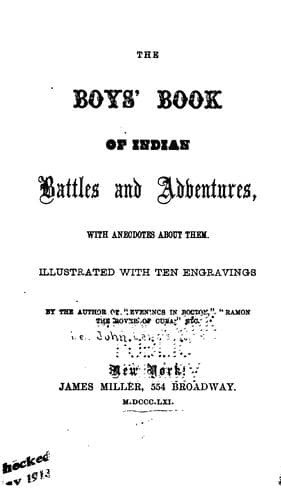
The boys' book of Indian battles and adventures, with anecdotes about them
History
The boys' book of Indian battles and adventures, with anecdotes about them
Indians of North America -- Anecdotes
Of what avail would it have been to set before this listening people
the terrors of the Almighty, and the doom of the guilty? This wise man
knew, by long experience as a minister, that the heart loves better to
be persuaded than terrified—to be melted than alarmed. The whole career
of the Indian’s life tended to freeze up the finer and softer feelings,
and make the more dark and painful passions familiar to him. He resolved
to strike a new chord, and when he saw the tear stream down their stern
faces, and the haughty head sink low on the breast, as he painted the
ineffable love of Christ, he said it was “a glorious and affecting
spectacle to see a company of perishing forlorn outcasts, so drinking
in the word of salvation.” The impressions this discourse produced,
were of a very favourable nature: as far as the chief, Waubon, was
concerned, they were never effaced. Afterwards the guest passed several
hours conversing with the Indians, and answering their questions. When
night came, he returned to the tent with the chief, and the people
entered their wigwams, or lay down around, and slept on the grass. What
were Eliot’s feelings on this night? At last, the longing of years was
accomplished; the fruit of his prayers was given to him.
“Could the walls of his loved study speak,” says his friend, “they would
tell of the entreaties poured forth before the Lord, of the days and
nights set apart with fasting—that thus, thus it might be.” A few of the
chiefs’ friends alone remained, after the people were retired. One of the
Christians perceived an Indian, who was hanging down his head, weeping;
the former went to him, and spoke encouraging words, after which he
turned his face to the wall, and wept yet more abundantly: soon after,
he rose and went out. “When they told me of his tears,” said Eliot, “we
resolved to go forth, and follow him into the wood, and speak to him.
The proud Indian’s spirit was quite broken: at last we parted, greatly
rejoicing for such sorrowing.”
He now resolved to continue his labours; but, on the 26th of November,
when he met the assembly of the Indians for the third time, he found
that, though many of them had constructed wigwams at the place of
meeting, for the more readily attending his ministry, his audience was
not so numerous as on the former occasions. The Powahs (or soothsayers)
had strictly charged the people not to listen to the instructions of the
English, and threatened them with death in case of disobedience. Having
warned his auditors against the impositions of these men, he proceeded to
discourse as formerly, and was heard with the greatest attention. “It is
wonderful,” observed one of his friends, “to see what a little light will
effect, even upon hearts and spirits most incapable.”
Public-domain text, read in full here on John Shaqi.
Reviews
Reviews
No reviews yet
Be the first to share your thoughts on this work.
Join the Discussion
Join the discussion
Sign in to leave a comment or review.
Sign InorCreate an account