Dialect literature, American; German Americans -- Poetry; Humorous poetry, American; Wit and humor
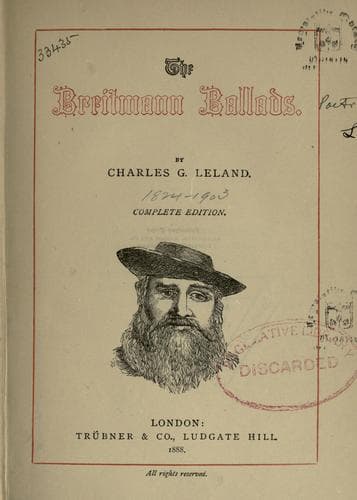
"HANS BREITMANN GIFE A BARTY" - the first of the poems here
submitted to the English public - appeared originally in 1857, in
Graham's Magazine, in Philadelphia, and soon became widely
known. Few American poems, indeed, have been held in better or
more constant remembrance than the ballad of "Hans Breitmann's
Barty;" for the words just quoted have actually passed into a
proverbial expression. The other ballads of the present
collection, likewise published in several newspapers, were first
collected in 1869 by Mr. Leland, the translator of Heine's
"Pictures of Travel" and "Book of Songs," and author of Meister
Karl's Sketch -Book," Philadelphia, 1856 and "Sunshine in
Thought," New York, 1863. They are much of the same character as
"The Barty" - most of them celebrating the martial career of
"Hans Breitmann," whose prototype was a German, serving during
the war in the 15th Pennsylvanian cavalry, and who - we have it
on good authority - was a man of desperate courage whenever a
cent could be made, and one who never fought unless
something could be made. The "rebs" "gobbled" him
one day; but he re-appeared in three weeks overloaded with money
and valuables. One of the American critics remarks: -
"Throughout all the ballads it is the same figure presented - an
honest 'Deutscher,' drunk with the New World as with new wine,
and rioting in the expression of purely Deutsch nature and
half-Deutsch ideas through a strange speech."
The poems are written in the dull broken English (not to be
confounded with the Pennsylvanian German) spoken by millions of -
mostly uneducated - Germans in America, immigrants to a great
extent from southern Germany. Their English has not yet become a
distinct dialect; and it would even be difficult to fix at
present the varieties in which it occurs. One of its prominent
peculiarities, however, is easily perceived: it consists in the
constant confounding of the soft and hard consonants; and the
reader must well bear it in mind when translating the language
that meets his eye into one to become intelligible to his ear.
Thus to the German of our poet, kiss becomes giss; company -
gompany; care - gare; count - gount; corner - gorner; till -
dill; terrible - derrible; time - dime; mountain - moundain;
thing - ding; through - droo; the - de; themselves - demselves;
other - oder; party - barty; place - blace; pig - big; priest -
breest; piano - biano; plaster - blaster; fine - vine; fighting -
vighting; fellow - veller; or, vice versa, he sounds got -
cot; green - creen; great - crate; gold dollars - cold tollars;
dam - tam; dreadful - treadful; drunk - troonk; brown - prown;
blood - ploot; bridge - pridge; barrel - parrel; boot - poot;
begging - peggin'; blackguard - plackguart; rebel - repel; never
- nefer; river - rifer; very - fery; give - gife; victory -
fictory; evening - efening; revive - refife; jump - shoomp; join
- choin; joy - choy; just - shoost; joke - choke; jingling -
Public-domain text, read in full here on John Shaqi.
Reviews
Reviews
No reviews yet
Be the first to share your thoughts on this work.
Join the Discussion
Join the discussion
Sign in to leave a comment or review.
Sign InorCreate an account