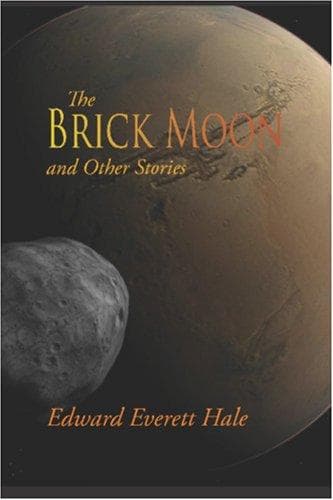
The Brick Moon, and Other StoriesHale, Edward Everett
Science
The Brick Moon, and Other Stories
Hale, Edward Everett
Short stories; United States -- Social life and customs -- 19th century -- Fiction
The latitude, which you have found, measures your
distance north or south from the equator or the pole. To
find your longitude, you want to find your distance
east or west from the meridian of Greenwich. Now, if any
one would build a good tall tower at Greenwich, straight
into the sky,--say a hundred miles into the sky,--of
course if you and I were east or west of it, and could
see it, we could tell how far east or west we were by
measuring the apparent height of the tower above our
horizon. If we could see so far, when the lantern with
a Drummond's light, "ever so bright," on the very top of
the tower, appeared to be on our horizon, we should know
we were eight hundred and seventy-three miles away from
it. The top of the tower would answer for us as the North
Star does when we are measuring the latitude. If we were
nearer, our horizon would make a longer angle with the
line from the top to our place of vision. If we were
farther away, we should need a higher tower.
But nobody will build any such tower at Greenwich, or
elsewhere on that meridian, or on any meridian. You see
that to be of use to the half the world nearest to it, it
would have to be so high that the diameter of the world
would seem nothing in proportion. And then, for the
other half of the world you would have to erect another
tower as high on the other side. It was this difficulty
that made Q. suggest the expedient of the Brick Moon.
For you see that if, by good luck, there were a ring
like Saturn's which stretched round the world, above
Greenwich and the meridian of Greenwich, and if it would
stay above Greenwich, turning with the world, any one
who wanted to measure his longitude or distance from
Greenwich would look out of window and see how high this
ring was above his horizon. At Greenwich it would be
over his head exactly. At New Orleans, which is quarter
round the world from Greenwich, it would be just in his
horizon. A little west of New Orleans you would begin to
look for the other half of the ring on the west instead
of the east; and if you went a little west of the Feejee
Islands the ring would be over your head again. So if we
only had a ring like that, not round the equator of the
world,--as Saturn's ring is around Saturn,--but vertical
to the plane of the equator, as the brass ring of an
artificial globe goes, only far higher in proportion,--
"from that ring," said Q., pensively, "we could calculate
the longitude."
Public-domain text, read in full here on John Shaqi.
Reviews
Reviews
No reviews yet
Be the first to share your thoughts on this work.
Join the Discussion
Join the discussion
Sign in to leave a comment or review.
Sign InorCreate an account