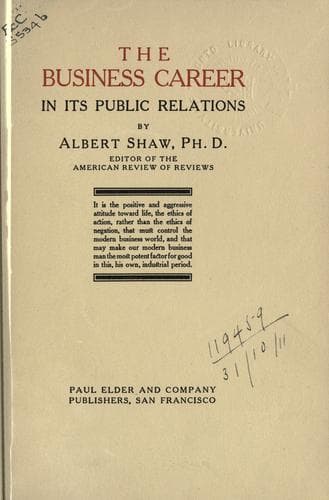
The business career in its public relationsShaw, Albert
Philosophy
The business career in its public relations
Shaw, Albert
Business ethics
Let us consider, briefly, the evolution of our present-day economic or
business life, and then take note of the necessary place that
particular classes of business men must hold in the structure of our
society. I, for my part, look upon this last century of economic
progress,--under the sway of what is often called "capitalism" as a
term of reproach,--as an immeasurable boon to mankind. It began with
the practical utilization of several great inventions, notably that of
steam power, which broke up the old household and village industries,
gave us the modern factory system, and along with the development of
railroads gave us the modern industrial city. This new and
revolutionizing system of industry and business forced its way into a
world of poverty, of disease, of depraved public life, of low morals in
the main pervading the community,--a world for the most part of class
distinctions in which the lot even of the privileged few was not a very
noble or enviable one, while the state of the vast majority was little
better than that of serfs.
Many writers have sought to throw a charm and a glamour over that old
condition of economic life and society that followed the break-up of
feudalism and that preceded the creation of our new political and
industrial institutions. But with some mitigations it was for most
people a period, as I have said, of squalor, disease, and degradation.
The fundamental trouble could be summed up in the one word, _poverty_.
The mission of the new industrial system, for the most part unconscious
and unrecognized, was to transform the world by abolishing the reign of
poverty. Doubtless it would be desirable if the improvement of
conditions, material and spiritual, could make progress with exactly
even pace on some perfectly symmetrical plan. But history shows us that
the forward social movement has proceeded first in one aspect, then in
another, on lines so tangential, often so zigzag, that it is difficult
until one gets distance enough for perspective, to see that any true
progress has been made at all.
Thus, the modern industrial system, which found the conditions of
poverty, disease, and hardship prevalent, seemed for quite a long time,
in its rude breaking up of old relations and its ruthless adherence to
certain newly proclaimed principles, to have brought matters from bad
to worse. The squalor and poverty of the village of hand-loom weavers
seemed only intensified in the new industrial towns to which the
weavers flocked from their deserted hamlets. Manufacturers were doing
business under the fiercest and most unregulated competition.
Economists were demonstrating their "law of supply and demand" and
their "iron law of wages" as capable in themselves of regulating all
the conditions and relations of business life. Epidemics raged and
depravity prevailed in the new factory centers.
Public-domain text, read in full here on John Shaqi.
Reviews
Reviews
No reviews yet
Be the first to share your thoughts on this work.
Join the Discussion
Join the discussion
Sign in to leave a comment or review.
Sign InorCreate an account