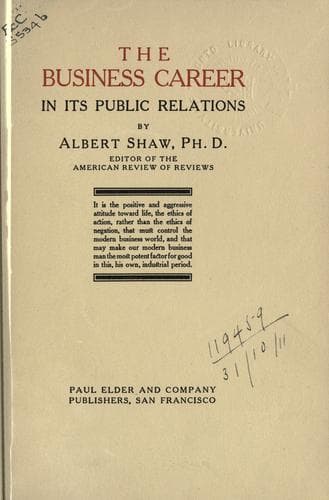
The business career in its public relations — John Shaqi
The business career in its public relationsShaw, Albert
Philosophy
The business career in its public relations
Shaw, Albert
Business ethics
But things were not, in reality, going from bad to worse. The
beginnings of a better order had to be based upon two things: first and
foremost, the sheer creation of capital; second, the discipline and
training of workers. In the first phases, the new modern business
period had to be a period of production. There had got to be developed
the instrumentalities for the creation of wealth. Until the industrial
system had raised up its class of efficient workers and had created its
great mass of capital for productive purposes, there could be no supply
of cheap goods; and without an abundant and cheap output there could be
no possible diffusion of economic benefits; in other words, no marked
amelioration of the prevailing poverty.
It required some development of wealth to lift our modern peoples out
of a poverty too grinding and too debasing for intellectual or moral
progress. It is true that the factory towns, created as they have all
been by modern industrial conditions during the past century, brought
their distinctive evils. There was overcrowding in ill-built tenement
houses; and long hours for women and children in the factories. Yet
with these and many other disadvantages, the new industrial system made
for discipline and for intelligence, and above all for a new kind of
solidarity and for a sense of brotherhood among workers.
In due time the worst evils began to be mitigated, largely through the
application of those very methods of organization which had
characterized the new kind of industry itself. Thus for men who had
applied steam power to manufacturing and had begun to build railroads,
it was soon perceived to be a matter not only of sanitary and social
service, but of pecuniary profit, to provide water supplies, public
illumination, and other conveniences to the crowded city dwellers.
Moreover, with the progress of industry and the development of
railroads and steam navigation, production and trade took on an
ever-increasing volume.
Then the world began to be less poor. There had been no rich men in the
modern sense, and of course no such thing as capitalized corporations
for production. The richest man in the United States at the time of his
death, a little more than a hundred years ago, was George Washington,
with his land and his slaves; and so in England and France there were
no rich men in the modern sense--that is to say, no men who controlled
great masses of productive capital. The men of wealth were those who
held landed estates. The chief business of all countries was
agriculture. The capitalistic system in industry and trade existed in
its rudiments and in limited measure; but all its great achievements
were yet to be wrought.
Public-domain text, read in full here on John Shaqi.
Reviews
Reviews
No reviews yet
Be the first to share your thoughts on this work.
Join the Discussion
Join the discussion
Sign in to leave a comment or review.
Sign InorCreate an account