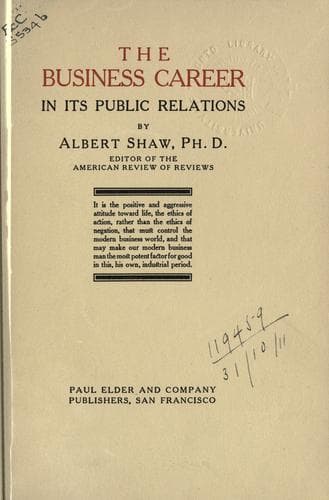
The business career in its public relationsShaw, Albert
Philosophy
The business career in its public relations
Shaw, Albert
Business ethics
The magnitude of our economic movement, the very splendor of the
opportunities that the swift development of a vast young country like
ours affords, must inevitably in some cases upset at once the sober
business judgment of men, and in some cases the standard of personal
honor and good faith, in the temptation to get rich quickly; so that
wrong is done thereby to a man's associates or to those whose interests
are in his hands, while still greater wrong is done to his own
character.
But, even against this dangerous greed for wealth and the
unscrupulousness and ruthlessness which it engenders, it is no part of
my present object to warn any young man. I take it that the negative
standards of private conduct are usually not much affected by a man's
choice of a pursuit in life. If any man's honor could be filched from
him by a merely pecuniary reward, whether greater or less, I should not
think it likely that he would be much safer in the long run if he chose
the clerical profession, for example, than if he went into business.
Sooner or later his character would disclose itself. It is not, then,
of the private and negative standards of conduct that I wish to
speak,--except by way of such allusions as these. And even these
allusions are only for the sake of making more distinct the positive
and active phases of business ethics that I should like to present in
such a way as to fasten them upon the attention.
Many young men, to whom these views are addressed, will doubtless
choose, or have already chosen, what is commonly known as a
professional career. The ministry, law, and medicine are the oldest and
best recognized of the so-called liberal or learned professions. Now
what are the distinctive marks of professional life? Are the men who
practice these professions not also business men? And if so, how are
they different from those business men who are considered laymen, or
non-professional? Obviously the distinctions that are to be drawn, if
any, are in the nature of marked tendencies. We shall not expect to
find any hard and fast lines. Many lawyers, some doctors, and a few
clergymen are clearly enough business men, in the sense that they
attach more importance to the economic bearings of the part they play
in the social organism than to the higher ethical or intellectual
aspects of their work.
Public-domain text, read in full here on John Shaqi.
Reviews
Reviews
No reviews yet
Be the first to share your thoughts on this work.
Join the Discussion
Join the discussion
Sign in to leave a comment or review.
Sign InorCreate an account