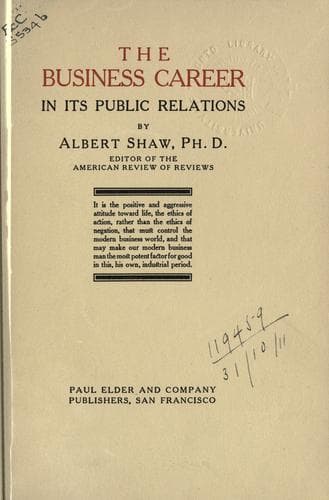
The business career in its public relationsShaw, Albert
Philosophy
The business career in its public relations
Shaw, Albert
Business ethics
I have read and heard many definitions of what really constitutes a
professional man. Whatever else, however, may characterize the nature
of his calling, it seems to me plain that no man can be thought a true
or worthy member of a profession who does not admit, both in theory and
in the rules and practices of his life, that he has a public function
to serve, and that he must frequently be at some discomfort or
disadvantage because of the calls of professional duty. The laborer is
worthy of his hire; and the professional man is entitled to obtain, if
he can, a competence for himself and his family from the useful and
productive service he is rendering to his fellow men. He may even,
through genius or through the great confidence his character and skill
inspire, gain considerable wealth in the practice of his profession.
But if he is a true professional man he does not derive his incentive
to effort solely or chiefly from the pecuniary gains that his
profession brings him. Nor is the amount of his income regarded among
the fellow members of his profession as the true test or measure of his
success.
Thus the lawyer, in the theory of his profession, bears an important
public relation to the dispensing of justice and to the protection of
the innocent and the feeble. He is not a private person, but a part of
the system for supporting the reign of law and of right in the
community. Historically, in this country, the lawyer has also borne a
great part in the making and administering of our institutions of
government. If, as some of us think, the ethical code of that
profession needs to be somewhat revised in view of present-day
conditions, and needs also to be more sternly applied to some of the
members of the profession, it is true, none the less, that there
clearly belongs to this great calling a series of duties of a public
nature, some of them imposed by the laws of the land, and others
inherent in the very nature of the occupation itself.
It is true in an even more marked and undeniable fashion that the
profession of medicine, by virtue of its public and social aspects, is
distinguished in a marked way from a calling in life in which a man
might feel that what he did was strictly his own business, subject to
nobody's scrutiny, or inquiry, or interference. The physician's public
obligation is in part prescribed by the laws of the State which
regulate medical practice, and in very large part by the professional
codes which have been evolved by the profession itself for its own
guidance. It is not the amount of his fee that the overworked doctor is
thinking about when he risks his own health in response to night calls,
or when he devotes himself to some especially painful or difficult
case. Nor is it a mere consideration of his possible earnings that
would deter him from seeking comfort and safety by taking his family to
Europe at a time when an epidemic had broken out in his own
neighborhood.
Public-domain text, read in full here on John Shaqi.
Reviews
Reviews
No reviews yet
Be the first to share your thoughts on this work.
Join the Discussion
Join the discussion
Sign in to leave a comment or review.
Sign InorCreate an account