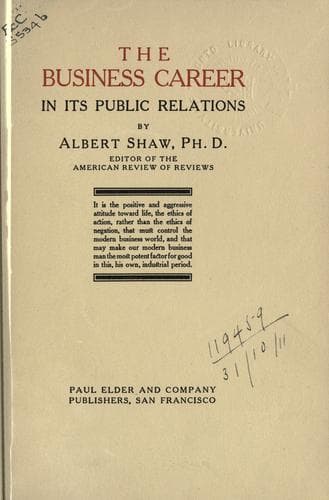
The business career in its public relationsShaw, Albert
Philosophy
The business career in its public relations
Shaw, Albert
Business ethics
I need not allude to the unselfish devotion to the good of the
community that in so high a degree marks the lives of most of the
members of the clerical profession, for this is evident to all
observant persons.
On the other hand, it cannot be too clearly perceived that there is
nothing in the disinterestedness, and in the obligation to render
public service characterizing professional life that amounts to
unnatural self-denial or painful renunciation,--unless in some extreme
and individual cases. On the contrary, professional life at its best
offers a great advantage in so far as it permits a man to think first
of the work he is doing and the social service he is rendering, rather
than of pecuniary reward. I have myself on more than one occasion
pointed out to young men the greater prospect for happiness in life
that comes with the choice of a calling in which the work itself
primarily focuses the attention, and in which the pecuniary reward
comes as an incident rather than as the conscious and direct result of
a given effort.
The greatest pleasure in work is that which comes from the trained and
regulated exercise of the faculty of imagination. In the conduct of
every law case this faculty has abundant opportunity, as it also has in
the efforts of the physician to aid nature in the restoration of health
and vigor in the individual, or in the sanitary protection of the
community. I hope I have made clear this point: that pecuniary success,
even in large measure, in the work of a professional man, may be
entirely compatible with disinterested devotion to a kind of work that
makes for the public weal, while it is also worthy of pursuit for its
own sake, and brings content and even happiness in the doing. And it is
clear enough, in the case of a professional man, that he is false to
his profession and to his plain obligations if he shows himself to be
ruled by the anti-social spirit; that is to say, if he considers
himself absolved from any duties towards the community about him;
thinks that the practice of his profession is a private affair for his
own profit and advantage, and holds that he has done his whole duty
when he has escaped liability for malpractice or disbarment.
Public-domain text, read in full here on John Shaqi.
Reviews
Reviews
No reviews yet
Be the first to share your thoughts on this work.
Join the Discussion
Join the discussion
Sign in to leave a comment or review.
Sign InorCreate an account