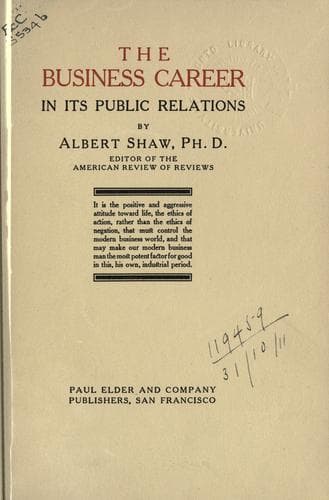
The business career in its public relations — John Shaqi
The business career in its public relationsShaw, Albert
Philosophy
The business career in its public relations
Shaw, Albert
Business ethics
But the three oldest and best recognized professions no longer stand
alone, in the estimation of our higher educational authorities and of
the intelligent public. In a democracy like ours, with a constantly
advancing conception of what is involved in education for citizenship
and for participation in every individual function of the social and
economic life, the work of the teacher comes to be recognized as
professional in the highest sense. Teaching, indeed, seems destined in
the near future to become the very foremost of all the professions.
This recognition will come when the idea takes full possession of the
public mind that the chief task of each generation is to train the next
one, and to transmit such stores of knowledge and useful experience as
it has received from its predecessors or has evolved for itself.
It is obvious enough that the work of the teacher gives room for the
play of the loftiest ideals, and that its functions are essentially
public and disinterested. But there are other callings, such as those
of the architect and engineer, which have also come to be spoken of as
professional in their nature. Their kinship to the older professions
has been more readily recognized by the men of conservative university
traditions, because much of the preparation for these callings can
advantageously be of an academic sort. Architecture in its historical
aspects is closely associated with the study of classical periods;
while the profession of the engineer relates itself to the immemorial
university devotion to mathematics. And in like manner the man who for
practical purposes becomes a chemist or an electrician would be easily
admitted by President Eliot, for example, to the favored fellowship of
the professional classes for the reason, first, of the disciplinary and
liberalizing nature of the studies that underlie his calling, and, in
the second place, of the public and social aspects of the functions he
fulfils in the pursuit of his vocation.
The architect, the civil or mechanical or electrical engineer, and the
chemist, as well as the professional teacher, the trained librarian, or
the journalist who carries on his work with due sense of its almost
unequaled public duties and responsibilities,--all these are now
admitted by dicta of our foremost authorities to a place equal with the
law, medicine, and the ministry in the list of the professions; that is
to say, in the group of callings which, under my definition, are
distinguished especially by their public character. And in this group,
of course, should be included politicians, legislators, and public
administrators in so far as they serve the public interests reputably
and in a professional spirit. Nor should we forget such special classes
of public servants as the officers of the army and navy; while nobody
will deny public character and professional rank to men of letters,
artists, musicians and actors.
Public-domain text, read in full here on John Shaqi.
Reviews
Reviews
No reviews yet
Be the first to share your thoughts on this work.
Join the Discussion
Join the discussion
Sign in to leave a comment or review.
Sign InorCreate an account