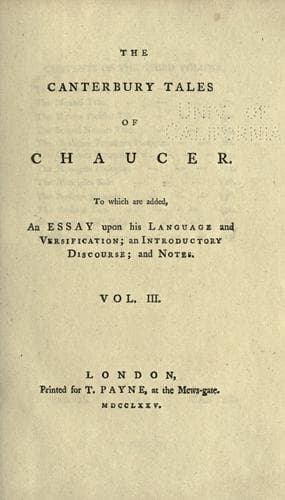
The Canterbury Tales, and Other PoemsChaucer, Geoffrey
ReligionChristian
The Canterbury Tales, and Other Poems
Chaucer, Geoffrey
Chaucer, Geoffrey, -1400; Christian pilgrims and pilgrimages -- Poetry; English poetry -- Middle English, 1100-1500
captivity; for his marriage is generally believed to have taken
place shortly after his release from foreign durance. He had
already gained the personal friendship and favour of John of
Gaunt, Duke of Lancaster, the King’s son; the Duke, while Earl
of Richmond, had courted, and won to wife after a certain
delay, Blanche, daughter and co-heiress of Henry Duke of
Lancaster; and Chaucer is by some believed to have written
“The Assembly of Fowls” to celebrate the wooing, as he wrote
“Chaucer’s Dream” to celebrate the wedding, of his patron. The
marriage took place in 1359, the year of Chaucer’s expedition to
France; and as, in “The Assembly of Fowls,” the formel or
female eagle, who is supposed to represent the Lady Blanche,
begs that her choice of a mate may be deferred for a year, 1358
and 1359 have been assigned as the respective dates of the two
poems already mentioned. In the “Dream,” Chaucer
prominently introduces his own lady-love, to whom, after the
happy union of his patron with the Lady Blanche, he is wedded
amid great rejoicing; and various expressions in the same poem
show that not only was the poet high in favour with the
illustrious pair, but that his future wife had also peculiar claims
on their regard. She was the younger daughter of Sir Payne
Roet, a native of Hainault, who had, like many of his
countrymen, been attracted to England by the example and
patronage of Queen Philippa. The favourite attendant on the
Lady Blanche was her elder sister Katherine: subsequently
married to Sir Hugh Swynford, a gentleman of Lincolnshire;
and destined, after the death of Blanche, to be in succession
governess of her children, mistress of John of Gaunt, and
lawfully-wedded Duchess of Lancaster. It is quite sufficient
proof that Chaucer’s position at Court was of no mean
consequence, to find that his wife, the sister of the future
Duchess of Lancaster, was one of the royal maids of honour,
and even, as Sir Harris Nicolas conjectures, a god-daughter of
the Queen — for her name also was Philippa.
Public-domain text, read in full here on John Shaqi.
Reviews
Reviews
No reviews yet
Be the first to share your thoughts on this work.
Join the Discussion
Join the discussion
Sign in to leave a comment or review.
Sign InorCreate an account