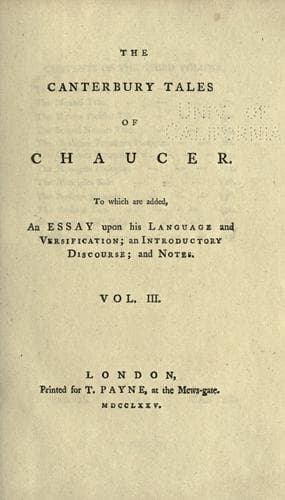
The Canterbury Tales, and Other PoemsChaucer, Geoffrey
ReligionChristian
The Canterbury Tales, and Other Poems
Chaucer, Geoffrey
Chaucer, Geoffrey, -1400; Christian pilgrims and pilgrimages -- Poetry; English poetry -- Middle English, 1100-1500
Between 1359, when the poet himself testifies that he was made
prisoner while bearing arms in France, and September 1366,
when Queen Philippa granted to her former maid of honour, by
the name of Philippa Chaucer, a yearly pension of ten marks, or
L6, 13s. 4d., we have no authentic mention of Chaucer, express
or indirect. It is plain from this grant that the poet’s marriage
with Sir Payne Roet’s daughter was not celebrated later than
1366; the probability is, that it closely followed his return from
the wars. In 1367, Edward III. settled upon Chaucer a life-
pension of twenty marks, “for the good service which our
beloved Valet — ‘dilectus Valettus noster’ — Geoffrey Chaucer
has rendered, and will render in time to come.” Camden
explains ‘Valettus hospitii’ to signify a Gentleman of the Privy
Chamber; Selden says that the designation was bestowed “upon
young heirs designed to he knighted, or young gentlemen of
great descent and quality.” Whatever the strict meaning of the
word, it is plain that the poet’s position was honourable and
near to the King’s person, and also that his worldly
circumstances were easy, if not affluent — for it need not be said
that twenty marks in those days represented twelve or twenty
times the sum in these. It is believed that he found powerful
patronage, not merely from the Duke of Lancaster and his wife,
but from Margaret Countess of Pembroke, the King’s daughter.
To her Chaucer is supposed to have addressed the “Goodly
Ballad”, in which the lady is celebrated under the image of the
daisy; her he is by some understood to have represented under
the title of Queen Alcestis, in the “Court of Love” and the
Prologue to “The Legend of Good Women;” and in her praise
we may read his charming descriptions and eulogies of the daisy
— French, “Marguerite,” the name of his Royal patroness. To
this period of Chaucer’s career we may probably attribute the
elegant and courtly, if somewhat conventional, poems of “The
Flower and the Leaf,” “The Cuckoo and the Nightingale,” &c.
“The Lady Margaret,” says Urry, “. . . would frequently
compliment him upon his poems. But this is not to be meant of
his Canterbury Tales, they being written in the latter part of his
life, when the courtier and the fine gentleman gave way to solid
sense and plain descriptions. In his love-pieces he was obliged
to have the strictest regard to modesty and decency; the ladies
at that time insisting so much upon the nicest punctilios of
honour, that it was highly criminal to depreciate their sex, or do
anything that might offend virtue.” Chaucer, in their estimation,
had sinned against the dignity and honour of womankind by his
translation of the French “Roman de la Rose,” and by his
“Troilus and Cressida” — assuming it to have been among his
less mature works; and to atone for those offences the Lady
Margaret (though other and older accounts say that it was the
first Queen of Richard II., Anne of Bohemia), prescribed to him
Public-domain text, read in full here on John Shaqi.
Reviews
Reviews
No reviews yet
Be the first to share your thoughts on this work.
Join the Discussion
Join the discussion
Sign in to leave a comment or review.
Sign InorCreate an account