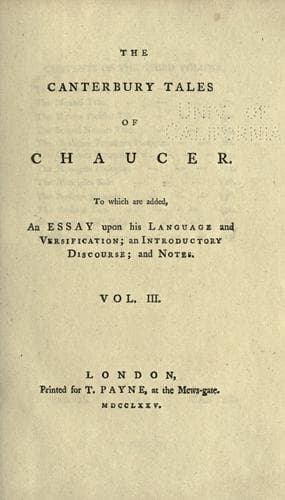
The Canterbury Tales, and Other PoemsChaucer, Geoffrey
ReligionChristian
The Canterbury Tales, and Other Poems
Chaucer, Geoffrey
Chaucer, Geoffrey, -1400; Christian pilgrims and pilgrimages -- Poetry; English poetry -- Middle English, 1100-1500
the task of writing “The Legend of Good Women” (see
introductory note to that poem). About this period, too, we
may place the composition of Chaucer’s A. B. C., or The Prayer
of Our Lady, made at the request of the Duchess Blanche, a
lady of great devoutness in her private life. She died in 1369;
and Chaucer, as he had allegorised her wooing, celebrated her
marriage, and aided her devotions, now lamented her death, in a
poem entitled “The Book of the Duchess; or, the Death of
Blanche.<3>
In 1370, Chaucer was employed on the King’s service abroad;
and in November 1372, by the title of “Scutifer noster” — our
Esquire or Shield-bearer — he was associated with “Jacobus
Pronan,” and “Johannes de Mari civis Januensis,” in a royal
commission, bestowing full powers to treat with the Duke of
Genoa, his Council, and State. The object of the embassy was
to negotiate upon the choice of an English port at which the
Genoese might form a commercial establishment; and Chaucer,
having quitted England in December, visited Genoa and
Florence, and returned to England before the end of November
1373 — for on that day he drew his pension from the Exchequer
in person. The most interesting point connected with this Italian
mission is the question, whether Chaucer visited Petrarch at
Padua. That he did, is unhesitatingly affirmed by the old
biographers; but the authentic notices of Chaucer during the
years 1372-1373, as shown by the researches of Sir Harris
Nicolas, are confined to the facts already stated; and we are left
to answer the question by the probabilities of the case, and by
the aid of what faint light the poet himself affords. We can
scarcely fancy that Chaucer, visiting Italy for the first time, in a
capacity which opened for him easy access to the great and the
famous, did not embrace the chance of meeting a poet whose
works he evidently knew in their native tongue, and highly
esteemed. With Mr Wright, we are strongly disinclined to
believe “that Chaucer did not profit by the opportunity . . . of
improving his acquaintance with the poetry, if not the poets, of
the country he thus visited, whose influence was now being felt
on the literature of most countries of Western Europe.” That
Chaucer was familiar with the Italian language appears not
merely from his repeated selection as Envoy to Italian States,
but by many passages in his poetry, from “The Assembly of
Fowls” to “The Canterbury Tales.” In the opening of the first
poem there is a striking parallel to Dante’s inscription on the
gate of Hell. The first Song of Troilus, in “Troilus and
Cressida”, is a nearly literal translation of Petrarch’s 88th
Sonnet. In the Prologue to “The Legend of Good Women”,
there is a reference to Dante which can hardly have reached the
poet at second- hand. And in Chaucer’s great work — as in The
Wife of Bath’s Tale, and The Monk’s Tale — direct reference by
name is made to Dante, “the wise poet of Florence,” “the great
Public-domain text, read in full here on John Shaqi.
Reviews
Reviews
No reviews yet
Be the first to share your thoughts on this work.
Join the Discussion
Join the discussion
Sign in to leave a comment or review.
Sign InorCreate an account