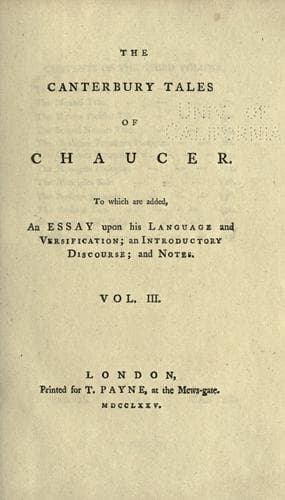
The Canterbury Tales, and Other Poems — John Shaqi
The Canterbury Tales, and Other PoemsChaucer, Geoffrey
ReligionChristian
The Canterbury Tales, and Other Poems
Chaucer, Geoffrey
Chaucer, Geoffrey, -1400; Christian pilgrims and pilgrimages -- Poetry; English poetry -- Middle English, 1100-1500
courage, resignation, and philosophic calm; and by the
“Retractation” at the end of The Canterbury Tales, which, if it
was not foisted in by monkish transcribers, may be supposed the
effect of Chaucer’s regrets and self-reproaches on that solemn
review of his life-work which the close approach of death
compelled. The poet was buried in Westminster Abbey; <12>
and not many years after his death a slab was placed on a pillar
near his grave, bearing the lines, taken from an epitaph or
eulogy made by Stephanus Surigonus of Milan, at the request of
Caxton:
“Galfridus Chaucer, vates, et fama poesis
Maternae, hoc sacra sum tumulatus humo.” <13>
About 1555, Mr Nicholas Brigham, a gentleman of Oxford who
greatly admired the genius of Chaucer, erected the present
tomb, as near to the spot where the poet lay, “before the chapel
of St Benet,” as was then possible by reason of the “cancelli,”
<14> which the Duke of Buckingham subsequently obtained
leave to remove, that room might be made for the tomb of
Dryden. On the structure of Mr Brigham, besides a full-length
representation of Chaucer, taken from a portrait drawn by his
“scholar” Thomas Occleve, was — or is, though now almost
illegible — the following inscription:—
M. S.
QUI FUIT ANGLORUM VATES TER MAXIMUS OLIM,
GALFRIDUS CHAUCER CONDITUR HOC TUMULO;
ANNUM SI QUAERAS DOMINI, SI TEMPORA VITAE,
ECCE NOTAE SUBSUNT, QUE TIBI CUNCTA NOTANT.
25 OCTOBRIS 1400.
AERUMNARUM REQUIES MORS.
N. BRIGHAM HOS FECIT MUSARUM NOMINE SUMPTUS
1556. <15>
Public-domain text, read in full here on John Shaqi.
Reviews
Reviews
No reviews yet
Be the first to share your thoughts on this work.
Join the Discussion
Join the discussion
Sign in to leave a comment or review.
Sign InorCreate an account