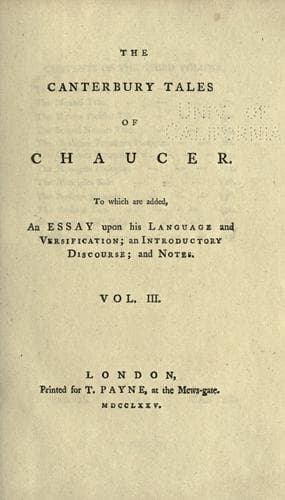
The Canterbury Tales, and Other Poems — John Shaqi
The Canterbury Tales, and Other PoemsChaucer, Geoffrey
ReligionChristian
The Canterbury Tales, and Other Poems
Chaucer, Geoffrey
Chaucer, Geoffrey, -1400; Christian pilgrims and pilgrimages -- Poetry; English poetry -- Middle English, 1100-1500
Concerning his personal appearance and habits, Chaucer has not
been reticent in his poetry. Urry sums up the traits of his aspect
and character fairly thus: “He was of a middle stature, the latter
part of his life inclinable to be fat and corpulent, as appears by
the Host’s bantering him in the journey to Canterbury, and
comparing shapes with him.<16> His face was fleshy, his
features just and regular, his complexion fair, and somewhat
pale, his hair of a dusky yellow, short and thin; the hair of his
beard in two forked tufts, of a wheat colour; his forehead broad
and smooth; his eyes inclining usually to the ground, which is
intimated by the Host’s words; his whole face full of liveliness, a
calm, easy sweetness, and a studious Venerable aspect. . . . As
to his temper, he had a mixture of the gay, the modest, and the
grave. The sprightliness of his humour was more distinguished
by his writings than by his appearance; which gave occasion to
Margaret Countess of Pembroke often to rally him upon his
silent modesty in company, telling him, that his absence was
more agreeable to her than his conversation, since the first was
productive of agreeable pieces of wit in his writings, <17> but
the latter was filled with a modest deference, and a too distant
respect. We see nothing merry or jocose in his behaviour with
his pilgrims, but a silent attention to their mirth, rather than any
mixture of his own. . . When disengaged from public affairs, his
time was entirely spent in study and reading; so agreeable to
him was this exercise, that he says he preferred it to all other
sports and diversions.<18> He lived within himself, neither
desirous to hear nor busy to concern himself with the affairs of
his neighbours. His course of living was temperate and regular;
he went to rest with the sun, and rose before it; and by that
means enjoyed the pleasures of the better part of the day, his
morning walk and fresh contemplations. This gave him the
advantage of describing the morning in so lively a manner as he
does everywhere in his works. The springing sun glows warm in
his lines, and the fragrant air blows cool in his descriptions; we
smell the sweets of the bloomy haws, and hear the music of the
feathered choir, whenever we take a forest walk with him. The
hour of the day is not easier to be discovered from the reflection
of the sun in Titian’s paintings, than in Chaucer’s morning
landscapes. . . . His reading was deep and extensive, his
judgement sound and discerning. . . In one word, he was a great
scholar, a pleasant wit, a candid critic, a sociable companion, a
steadfast friend, a grave philosopher, a temperate economist,
and a pious Christian.”
Public-domain text, read in full here on John Shaqi.
Reviews
Reviews
No reviews yet
Be the first to share your thoughts on this work.
Join the Discussion
Join the discussion
Sign in to leave a comment or review.
Sign InorCreate an account