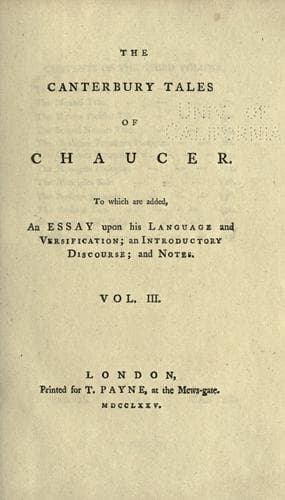
The Canterbury Tales, and Other Poems — John Shaqi
The Canterbury Tales, and Other PoemsChaucer, Geoffrey
ReligionChristian
The Canterbury Tales, and Other Poems
Chaucer, Geoffrey
Chaucer, Geoffrey, -1400; Christian pilgrims and pilgrimages -- Poetry; English poetry -- Middle English, 1100-1500
Chaucer’s most important poems are “Troilus and Cressida,”
“The Romaunt of the Rose,” and “The Canterbury Tales.” Of
the first, containing 8246 lines, an abridgement, with a prose
connecting outline of the story, is given in this volume. With the
second, consisting of 7699 octosyllabic verses, like those in
which “The House of Fame” is written, it was found impossible
to deal in the present edition. The poem is a curtailed translation
from the French “Roman de la Rose” — commenced by
Guillaume de Lorris, who died in 1260, after contributing 4070
verses, and completed, in the last quarter of the thirteenth
century, by Jean de Meun, who added some 18,000 verses. It is
a satirical allegory, in which the vices of courts, the corruptions
of the clergy, the disorders and inequalities of society in general,
are unsparingly attacked, and the most revolutionary doctrines
are advanced; and though, in making his translation, Chaucer
softened or eliminated much of the satire of the poem, still it
remained, in his verse, a caustic exposure of the abuses of the
time, especially those which discredited the Church.
The Canterbury Tales are presented in this edition with as near
an approach to completeness as regard for the popular character
of the volume permitted. The 17,385 verses, of which the
poetical Tales consist, have been given without abridgement or
purgation — save in a single couplet; but, the main purpose of
the volume being to make the general reader acquainted with
the “poems” of Chaucer and Spenser, the Editor has ventured to
contract the two prose Tales — Chaucer’s Tale of Melibœus,
and the Parson’s Sermon or Treatise on Penitence — so as to
save about thirty pages for the introduction of Chaucer’s minor
pieces. At the same time, by giving prose outlines of the omitted
parts, it has been sought to guard the reader against the fear
that he was losing anything essential, or even valuable. It is
almost needless to describe the plot, or point out the literary
place, of the Canterbury Tales. Perhaps in the entire range of
ancient and modern literature there is no work that so clearly
and freshly paints for future times the picture of the past;
certainly no Englishman has ever approached Chaucer in the
power of fixing for ever the fleeting traits of his own time. The
plan of the poem had been adopted before Chaucer chose it;
notably in the “Decameron” of Boccaccio — although, there, the
circumstances under which the tales were told, with the terror
of the plague hanging over the merry company, lend a grim
grotesqueness to the narrative, unless we can look at it
abstracted from its setting. Chaucer, on the other hand, strikes
a perpetual key-note of gaiety whenever he mentions the word
“pilgrimage;” and at every stage of the connecting story we
bless the happy thought which gives us incessant incident,
movement, variety, and unclouded but never monotonous
joyousness.
Public-domain text, read in full here on John Shaqi.
Reviews
Reviews
No reviews yet
Be the first to share your thoughts on this work.
Join the Discussion
Join the discussion
Sign in to leave a comment or review.
Sign InorCreate an account