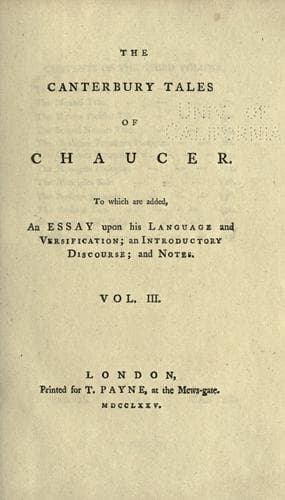
The Canterbury Tales, and Other PoemsChaucer, Geoffrey
ReligionChristian
The Canterbury Tales, and Other Poems
Chaucer, Geoffrey
Chaucer, Geoffrey, -1400; Christian pilgrims and pilgrimages -- Poetry; English poetry -- Middle English, 1100-1500
The poet, the evening before he starts on a pilgrimage to the
shrine of St Thomas at Canterbury, lies at the Tabard Inn, in
Southwark, curious to know in what companionship he is
destined to fare forward on the morrow. Chance sends him
“nine and twenty in a company,” representing all orders of
English society, lay and clerical, from the Knight and the Abbot
down to the Ploughman and the Sompnour. The jolly Host of
the Tabard, after supper, when tongues are loosened and hearts
are opened, declares that “not this year” has he seen such a
company at once under his roof-tree, and proposes that, when
they set out next morning, he should ride with them and make
them sport. All agree, and Harry Bailly unfolds his scheme: each
pilgrim, including the poet, shall tell two tales on the road to
Canterbury, and two on the way back to London; and he whom
the general voice pronounces to have told the best tale, shall be
treated to a supper at the common cost — and, of course, to
mine Host’s profit — when the cavalcade returns from the saint’s
shrine to the Southwark hostelry. All joyously assent; and early
on the morrow, in the gay spring sunshine, they ride forth,
listening to the heroic tale of the brave and gentle Knight, who
has been gracefully chosen by the Host to lead the spirited
competition of story-telling.
To describe thus the nature of the plan, and to say that when
Chaucer conceived, or at least began to execute it, he was
between sixty and seventy years of age, is to proclaim that The
Canterbury Tales could never be more than a fragment. Thirty
pilgrims, each telling two tales on the way out, and two more
on the way back — that makes 120 tales; to say nothing of the
prologue, the description of the journey, the occurrences at
Canterbury, “and all the remnant of their pilgrimage,” which
Chaucer also undertook. No more than twenty-three of the 120
stories are told in the work as it comes down to us; that is, only
twenty-three of the thirty pilgrims tell the first of the two stories
on the road to Canterbury; while of the stories on the return
journey we have not one, and nothing is said about the doings
of the pilgrims at Canterbury — which would, if treated like the
scene at the Tabard, have given us a still livelier “picture of the
period.” But the plan was too large; and although the poet had
some reserves, in stories which he had already composed in an
independent form, death cut short his labour ere he could even
complete the arrangement and connection of more than a very
few of the Tales. Incomplete as it is, however, the magnum
opus of Chaucer was in his own time received with immense
favour; manuscript copies are numerous even now — no slight
proof of its popularity; and when the invention of printing was
introduced into England by William Caxton, The Canterbury
Tales issued from his press in the year after the first English-
printed book, “The Game of the Chesse,” had been struck off.
Public-domain text, read in full here on John Shaqi.
Reviews
Reviews
No reviews yet
Be the first to share your thoughts on this work.
Join the Discussion
Join the discussion
Sign in to leave a comment or review.
Sign InorCreate an account