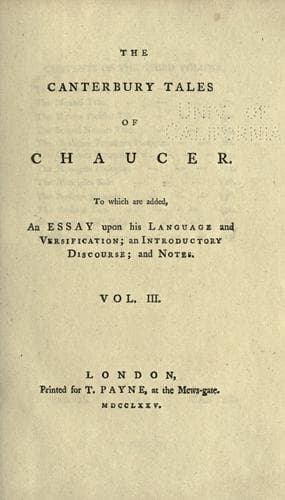
The Canterbury Tales, and Other PoemsChaucer, Geoffrey
ReligionChristian
The Canterbury Tales, and Other Poems
Chaucer, Geoffrey
Chaucer, Geoffrey, -1400; Christian pilgrims and pilgrimages -- Poetry; English poetry -- Middle English, 1100-1500
Innumerable editions have since been published; and it may
fairly be affirmed, that few books have been so much in favour
with the reading public of every generation as this book, which
the lapse of every generation has been rendering more
unreadable.
Apart from “The Romaunt of the Rose,” no really important
poetical work of Chaucer’s is omitted from or unrepresented in
the present edition. Of “The Legend of Good Women,” the
Prologue only is given — but it is the most genuinely Chaucerian
part of the poem. Of “The Court of Love,” three-fourths are
here presented; of “The Assembly of Fowls,” “The Cuckoo and
the Nightingale,” “The Flower and the Leaf,” all; of “Chaucer’s
Dream,” one-fourth; of “The House of Fame,” two-thirds; and
of the minor poems such a selection as may give an idea of
Chaucer’s power in the “occasional” department of verse.
Necessarily, no space whatever could be given to Chaucer’s
prose works — his translation of Boethius’ Treatise on the
Consolation of Philosophy; his Treatise on the Astrolabe,
written for the use of his son Lewis; and his “Testament of
Love,” composed in his later years, and reflecting the troubles
that then beset the poet. If, after studying in a simplified form
the salient works of England’s first great bard, the reader is
tempted to regret that he was not introduced to a wider
acquaintance with the author, the purpose of the Editor will
have been more than attained.
The plan of the volume does not demand an elaborate
examination into the state of our language when Chaucer wrote,
or the nice questions of grammatical and metrical structure
which conspire with the obsolete orthography to make his
poems a sealed book for the masses. The most important
element in the proper reading of Chaucer’s verses — whether
written in the decasyllabic or heroic metre, which he introduced
into our literature, or in the octosyllabic measure used with such
animated effect in “The House of Fame,” “Chaucer’s Dream,”
&c. — is the sounding of the terminal “e” where it is now silent.
That letter is still valid in French poetry; and Chaucer’s lines can
be scanned only by reading them as we would read Racine’s or
Molière’s. The terminal “e” played an important part in
grammar; in many cases it was the sign of the infinitive — the
“n” being dropped from the end; at other times it pointed the
distinction between singular and plural, between adjective and
adverb. The pages that follow, however, being prepared from
the modern English point of view, necessarily no account is
taken of those distinctions; and the now silent “e” has been
retained in the text of Chaucer only when required by the
modern spelling, or by the exigencies of metre.
Public-domain text, read in full here on John Shaqi.
Reviews
Reviews
No reviews yet
Be the first to share your thoughts on this work.
Join the Discussion
Join the discussion
Sign in to leave a comment or review.
Sign InorCreate an account